Tag Archives: COVID-19

Baseball is Still Trying to Save Season as Other Sports Hit Cruise Control

As Major League Baseball’s owners and players continue to haggle over the parameters of what a 2020 season would look like in terms of number of games played and percentage of compensation, NASCAR and IndyCar are up and running, and the NBA is about to be up and running.

NASCAR which became the first major professional sports league to return to action last month, is set to hit another milestone on June 14 when it allows some fans into the track to see the action in person. Welcoming of fans into the facility comes with restrictions, and is also occurring during a time when nearly half of the states in the United States are seeing the number of cases of COVID-19 go up. It is also occurring as other states are being questioned about whether they are providing an accurate count of the total number of COVID-19 cases within their communities.

Make no mistake, these are truly uncharted waters, and the entire process is just one big wave away from capsizing faster than the ship in The Poseidon Adventure. Still, for many it is full steam ahead, into the great wide open.

The fact that other sports leagues are resuming their interrupted seasons is placing added pressure on MLB to start their 2020 season, which was originally scheduled to begin on March 26. While the main issues preventing the MLB from playing ball seem to be mostly financial, not all of the players are being affected the same way.

Established MLB players, and recently drafted Minor League Baseball (MiLB) players, can easily sit out the season if it comes down to it since for the most part their jobs are safe.

The fact that other sports leagues are resuming their interrupted seasons is placing added pressure on MLB to start their 2020 season, which was originally scheduled to begin on March 26.
Photo R. Anderson

For other players, a lost season could cost them their last chance to make it onto a Big-League roster and leave the long bus rides of MiLB behind.

I have been thinking a lot about those players in both affiliated and independent baseball lately. As I have noted several times before, I cut my Ballpark teeth by mostly watching Southern League baseball when I was growing up. In recent years, despite being located closer to an MLB Ballpark, than an Independent League Ballpark, I have found myself driving the extra 20 minutes and spending more time watching the Sugar Land Skeeters of the Atlantic League of Professional Baseball (ALPA) than the Houston Astros.

Nothing says Ballpark fun quite like a mascot adjacent box seat near the dugout. Isn’t that right Swatson?
Photo R. Anderson

For me, Minor League Baseball is a purer form of the game and allows me to be closer to the field for the same price as a nosebleed ticket at an MLB Ballpark. With Minor League Ballparks being about a third of the size of their Major League counterparts, one can really get up close and personal to the action.

Unfortunately, those Minor League players that I enjoy watching the most are the ones who are finding uncertain futures, as well as uneasy presents. To their credit many MLB teams and players have offered to pay the salaries of the players in their farm systems. However, with efforts to reduce the number of MiLB teams, as well as reducing the number of players drafted, in the coming years, there will be far fewer people who will get to chase their dreams of making it to the Show.

Of course, less affiliated Minor League baseball should mean an uptick in players wanting to play Independent League baseball which may lead to the rise of new leagues and teams to fill the void left behind following any contraction of affiliated baseball.

When I was in high school, I had a friend who was a star pitcher on the school baseball team. The team made it to the state playoffs my junior year. The following year, it was not uncommon to see various pro scouts in the stands.

My friend was a southpaw pitcher, which was then, and continues to be a hot commodity sought after by many MLB clubs. My friend ended up signing with the New York Yankees in the second round of the MLB June Amateur Draft right out of high school and as Tom Petty would say, “the future was wide open.”

Setbacks on the field, as well as off the field, led him to bounce around the Minor Leagues like a fan trying to reach first base in a dizzy bat race. My friend spent six years in the Yankees organization and never advanced above AA ball, as well as playing four years of Independent League baseball. Over 10 seasons he had a career .513 winning percentage, and a career 4.32 earned run average (ERA). After 10 years of chasing the dream my friend finally called it a career without so much as a cup of coffee in the show.

My friend spent six years in the Yankees organization and never advanced above AA ball, as well as playing four years of Independent League baseball proving that not every dream of playing MLB ball comes true.
Photo R. Anderson

There are thousands of players just like my friend who seek the bright lights of big-league ballparks only to find their dreams cut short. While the answer varies depending on who you ask, most people can agree that only about 10 to 20 percent of the people drafted by MLB teams will ever make it to the Majors.

So, the thinking goes that by reducing the number of teams and the rounds in the draft MLB is forcing people who wouldn’t have made it to the MLB anyway to start their post baseball playing days earlier.

Many will bounce along as long as possible chasing the dream until the realities of life and family commitments lead them to a steadier form of work. These players are the real Crash Davis types, in honor of the character Kevin Costner played in Bull Durham.

I lost track of my friend a few years before the end of his career but would still follow his career whenever I saw a blurb on one of the Minor League sites. I hope he is doing well for himself and that he landed on his feet after he hung up his glove for the last time.

Whenever baseball does resume it will be different on so many fronts. COVID-19 exposed a crack in the professional sports diversion that people have counted on to get them through so many other trying times in the past. Now that people know that sports are not the recession proof, tragedy proof, and pandemic proof light in a time of darkness that they thought they were, people will need to decide whether they will still put their trust in sports to distract and comfort them, or if they will find other ways to deal with whatever life throws at them.

In many ways, we are all Minor League players trying to hang on to the dream for one more season, while knowing in the back of our heads that at some point we will need to put our cleats away and face life head on.

Now if you’ll excuse me, I have a sudden urge to watch Bull Durham.

Copyright 2020 R. Anderson
Social Experiment on Value of Social Distancing to Face Biggest Test as Sports World Watches

Throughout the worldwide timeout brought about by the COVID-19 virus, there have been two main schools of thought related to the value of people social distancing to avoid spreading the virus.

One school of thought, let’s call them science, maintains that the best way to mitigate the spread of a virus, that has no cure, and no proven treatment, is to stay six feet apart, wear masks when around other people, wash hands constantly, and avoid touching the mouth and nose area.

The other school of thought, let’s call them Sweden, believes that the virus that has killed over 109,000 Americans, and over 330,000 people worldwide, will go away on its own, and that people should just roll the dice and go about their lives as if a huge global pandemic was not hanging over their heads in an effort to establish herd immunity equipped with the knowledge that one has to break a few eggs to make an omelette.

There are of course nuggets of truth to each side’s position, since no one really knows for sure how this brand-new virus will finally ramp down. Team science is right in saying that smaller gatherings of people mean less opportunities to spread the virus. At the same time, team Sweden is also right in saying that one cannot stay isolated forever.

While the two camps differ on the value of social distancing as a whole, one thing that both sides should be able to agree on, is that minority populations, elderly populations, and populations with underlying health conditions should take extra precautions related to how they respond to the threat of COVID-19.

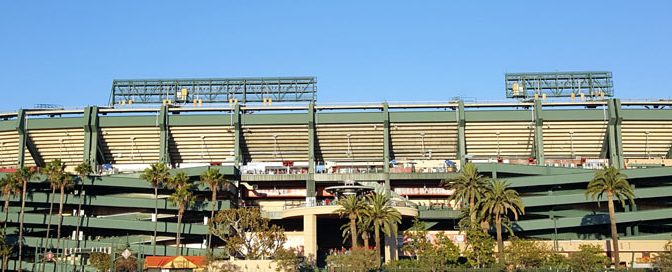
To a certain degree, each and every one of us is free to decide which camp we want to belong to, sort of like the people of Los Angeles have the choice between rooting for the Angels, or the Dodgers. One team wins a lot, has a storied history, and has their own unique hot dog. The other team is the Angels.

To a certain degree, each and every one of us is free to decide which camp we want to belong to when it comes to social distancing, or not social distancing during the time of COVID-19, just like the people of Los Angeles have the choice between rooting for the Angels, or the Dodgers. One team wins a lot, has a storied history, and has their own unique hot dog. The other team is the Angels.
Photo R. Anderson

Starting today, the two COVID-19 camps are likely to see which approach to social distancing was the right call. The data points come courtesy of 14 days of coast to coast protests acting as a major case study in what happens when thousands of people occupy the same space for extended periods of time in the midst of a pandemic.

Although many people have been seen wearing masks during television coverage of the protests, there are also many people who are not wearing masks. Additionally, with additional law enforcement and media members on the street in close proximity many cities are facing the equivalent of filling several Ballparks multiple times each day.

The widely agreed upon incubation period for COVID-19 is around two weeks. So, with today marking the 14th day since the protests began, any wide-spread outbreaks of the virus should start to materialize any day now, and will last for up to two weeks after the last protest. There are very few historical data points for what happens when one protests during a global pandemic, so a lot of new ground is being plowed on both the social justice front as well as on a medical front.

This is where the world of sports will be sure to take notice as they try to determine when, and how to reintroduce players onto the field, and fans into the stands. If team science is right, the numbers of infections will spike as a result of the proximity of protesters, and a lack of adherence to social distancing guidelines. This would show to the sports leagues around the world that the risk of bringing fans into the stands is still very high.

If team Sweden is right, cases will not spike and calls to open everything up the way they were before the middle of March 2020 will grow louder. Of course, the wrinkle to solely relying on visible symptoms of COVID-19 in determining a path forward is that many of the cases of COVID-19 do not lend themselves to outward signs of symptoms. So, even if there is a widespread outbreak, it would likely not be revealed unless people partaking in the protests were tested for the virus.

With several professional and collegiate sports teams reporting COVID-19 cases after players have started returning to practice, it becomes clear that there is risk even without fans in the stands.

Scott Dixon, shown following the 2013 Grand Prix of Houston, won the first race of the delayed 2020 IndyCar season at Texas Motor Speedway. Although fans were not at the race in Texas, series officials have said that fans will be in attendance when the crown jewel Indy 500 is run even if that means delaying the race beyond the current August time frame.
Photo R. Anderson

The desire of professional sports leagues to pack as many fans into the stands as quickly as possible is both a financial need, as well as a psychological need.

Although the Indy Car Series returned to action for the first time in 2020 this past weekend with a fan free race at Texas Motor Speedway, series officials went on record as saying that the Indianapolis 500, which has been moved from May to August, would be delayed again in the event that fans cannot attend an August race.

The message being sent is loud and clear, the Indy 500 will not happen without butts in the seats, even if that means there is no Indy 500 this year.

While the Indy 500 is a significant race, allowing some races to be held without fans in order to generate revenue, but saying that the INDY 500 is too important of a race to run without fans seems like an insult to the other races on the schedule.

That would be like Major League Baseball saying that the Yankees are too important to the history of the game to play in an empty Ballpark, so fans can pile into Yankee Stadium, but the other 29 Ballparks need to remain empty.

The Indy 500 is the largest single-day sporting event in the world, and with room for over 400,000 spectators, the Indianapolis Motor Speedway is often recognized as the largest sports venue in the world. It is hard to imagine any scenario where 400,000 people are going to be allowed to congregate anywhere, anytime soon during the COVID-19 pandemic.

Even at 25 percent capacity, an Indy 500 with 100,000 people seems like a bit of a stretch and would be something that would certainly make team science cringe. On the other hand, team Sweden would likely say, “och förarna startar dina motorer,” or roughly translated as “drivers start your engines.”

That is why the infection rates coming out of the weeks of protest will be so crucial in planning the next front in the battle against the COVID-19 virus.

Sports and science are both driven by statistics. The near-term future of professional and collegiate sports is very likely to be determined by what the rate of infection looks like over the coming weeks. It is a case study that no one could have envisioned at the start of the pandemic when the world of sports shut down one league at a time. Now that it has happened, the numbers cannot be ignored, just as the issues behind what led to the protests will also need to be addressed in the sports world, as well as the world as a whole.

COVID-19, as well as the protests for social justice that are occurring in the middle of a pandemic will both shape the direction of the world both in the short-term, as well as the long-term. There is no question that history is being written. Time will tell what those history books end up saying when all is said and done.

Now if you’ll excuse me, all of this talk about team Sweden has me wanting to build an armoire using a tiny wrench that can also double as a meatball skewer.

Copyright 2020 R. Anderson

Asking the Hard-Hitting Questions About Bobbleheads in a Ballpark

Here at the gigaplex news desk we like to tackle the big issues from time to time in honor of our days as a hard-hitting news reporter pounding the pavement in search of a scoop.

We do this, because ink runs through our veins, in addition to doing it in order to keep those journalistic skills sharpened in case this whole sports thing falls apart, and it is back to days of covering school board meetings, investigating pet crematoriums, and interviewing families living on lead tainted land.

There are so many stories to be told if one just stops to listen, and asks the right questions to get the answers that need to see the light of day. Good journalism brings those stories to the masses.

So, it is in that spirit of hard-hitting investigative journalism that we find ourselves asking the question that is no doubt on everyone’s mind. If a bobblehead falls in an empty ballpark, and no one is there to see it,  does its head go up and down?

In warehouses and store rooms around the world there are boxed bobbleheads waiting for a chance to be given away once fans return to Ballparks.
Photo R. Anderson

I mean, the simple answer is that if you ask the bobblehead, they will no doubt say yes. This should not come as a surprise to anyone, since literally the only answer a bobblehead can give to any question is yes. Because, you know, the whole fact that they are a bobblehead whose one job in the entire world is to nod up and down.

Of course, wearing our hard news hat, we were not going to just take a bobblehead at their world. I mean can you really trust a yes bobble? At least a Magic Eight Ball has the decency to tell you, “Reply hazy, try again,” if it is not ready to answer a question without just always answering in the affirmative.

So, once it was determined that a bobblehead could not be trusted to answer truthfully, the investigative issue became how best to get to the bottom of answering this bobbleheaded conundrum that has no doubt caused numerous philosophers to at least give it a minor bit of thought.

We could be sitting on a huge conspiracy theory, that is about to blow the head bobbing lid off of the entire thing. Either that or we could just be sitting on a big pile of cardboard boxes.

Perhaps that is why Major League Baseball is still at an impasse related to whether to start the season. People were getting too close to the truth and they needed more time to hide the answer along with the Illuminbobbleati.

The question on everyone’s mind is what did the bobblehead know and when did he know it?
Photo R. Anderson

(Mental note, stop binging X-Files into the wee hours of the morning, it is making you paranoid. Who said that?)

Just think about it. Right now, Ballparks across the country are likely filled with boxes of bobbleheads that were set to be given away to fans during games this year. With no fans, and no games so far, the bobbleheads are just sitting in a store room in the bowels of a promotions closet haphazardly stacked there by an intern who quite possibly can’t believe that they are getting college credit to stack boxes of bobbleheads.

Of course, it is also possible that thanks to the impacts on international shipping, brought about by the COVID-19 pandemic, that the nation’s 2020 bobblehead inventory is sitting in a warehouse somewhere in China, and that the intern never had the chance to stack them in that aforementioned promotions closet. After all, the gloves I ordered from China three months ago still have not arrived, so there is definitely some shipping delays on the slow boats from China.

What really goes on inside a bobblehead’s box when no one is there to see it?
Photo R. Anderson

In the big picture, with no games and no fans in the Ballpark, it does not really matter whether the bobbleheads are stateside, or still in their country of origin since they won’t be getting passed out any time soon.

So, with this new wrinkle of the nation’s supply of bobbleheads potentially being trapped overseas, we sought to go right to the source and really explore the issue with the full resources of our entire Action News Team of one.

We then realized that international travel is kind of hit and miss right now, so, flying to China to witness how the bobbleheads are made was probably not the best thing to do.

So, with travel to China ruled out, we did the next best thing and asked Google how bobbleheads were made in an attempt to see whether something in that process would tell us whether they would indeed bobble after a fall in an empty ballpark. Google basically told us that the most common bobbleheads are made from resin and plastic and that they involve a spring.

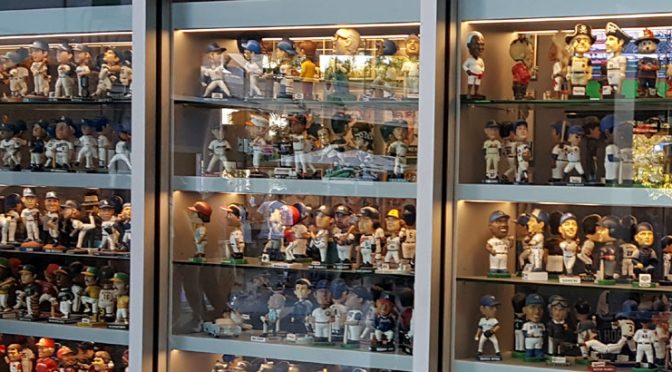
Dodger Stadium has an impressive display of bobbleheads but it is still unknown whether a bobblehead falling in an empty Ballpark nods its head up and down.
Photo R. Anderson

I am not sure what additional details I was expecting Google to have given me, but the response was entirely underwhelming. I mean I can look at a bobblehead and know that it is resin and plastic with a spring. Worst of all, now my browser and Gmail are clogged with ads telling me about the bobbleheads I can buy, and I am no closer to answering the question that started this all.

On a side note, if anyone is interested in commemorating the Spring/Summer/Fall/Winter of COVID-19 I did learn that they can order bobbleheads of infectious diseases experts Dr. Fauci and Dr. Birx.

In our investigation into bobbleheads we encountered some bull.
Photo R. Anderson

In the end, it was determined that the world may not be ready to learn the truth of what happens when a bobblehead falls in an empty Ballpark.

For now, it shall remain an open case, just like the age-old debate pertaining to how many licks it takes to get to the center of a Tootsie Pop. I never did trust that Mr. Owl. I just know he is hiding something underneath those big glasses of his.

While I failed to get to the bottom of my investigation of bobbleheads, to all of my fellow journalists out there working tirelessly day and night to tell the stories that need to be told, keep up the good work.

Now if you’ll excuse me, I am off to watch some more X-Files. I really hope the Smoking Man is in this one.

Copyright 2020 R. Anderson

Negotiations Continue in Quest for MLB to Play Ball in 2020

Negotiations continue to heat up between representatives of baseball owners, and representatives of baseball players, in an attempt to salvage some sort of 2020 Major League Baseball (MLB) season.

One of the latest rumors floating around, as reported by several outlets, includes a proposal from the owners to play a 50-game season, followed by expanded playoffs and a World Series. The players representatives have proposed playing as many as 114-games starting around the July Fourth Weekend.

As I have stated many times, I miss baseball and would love to see it played again. I have also said many times, in many ways, that I do not miss baseball to the point that I would want to see a fan-free condensed season just so someone can pat themselves on the back and say, “hooray, we had a 2020 MLB season.” Fifty games a season does not make. Even at 114 games, the risk trade of having a season, versus not having a season does not come out in favor of playing ball.

As part of the proposals being floated around it was reported that players will have the option to sit the season out if they do not feel safe playing ball in the era of the global COVID-19 pandemic. While players would not be paid if they sit the season out, they would get credited with a year of baseball service.

Baseball in the olden days, like during Spring Training of this year, involved crammed dugouts. The baseball in the new time of COVID-19 will look very different.
Photo R. Anderson

Any final agreement on playing the 2020 baseball season must allow players to opt out, and I applaud that position being addressed through the negotiations.

While I am firmly entrenched in my stance that baseball just needs to sit this year out and try again next year, I know that there are people who will disagree. This other side of the coin from my position feels that having baseball, any baseball, is just what is needed during these times of pandemic and civil unrest.

Although I do not agree with that position, I respect that position, just as I would hope that people on the other side would respect mine. Society works best when people can have a healthy productive debate on an issue, agree to disagree, and part with respect for the other person’s opinion.

But from where I am sitting, I have yet to hear a strong enough case that baseball, any amount of baseball, this year would be in the best interest of all involved. Let me state my case.

I get that there are huge financial stakes for both the owners and the players if baseball is not played this year. I also understand that the players in the Minor League Baseball (MiLB) ranks are being hardest hit by a lack of games, as in many cases they are about to lose their paychecks.

Sean Doolittle and other members of the Defending World Series Champion Washington Nationals, committed to give MiLB players within the Nationals organization financial assistance during the time without baseball.
Photo R. Anderson

In regards to the players of MiLB, I am encouraged by the stories of MLB players, like, David Price of the Los Angeles Dodgers, and Sean Doolittle and other members of the Washington Nationals, committing to give MiLB players financial assistance.

In making the announcement on his Twitter page, Doolittle noted that, “All of us were minor leaguers at one point in our careers and we know how important the weekly stipends are for them and their families during these uncertain times.”

I am also encouraged by the stories I see of MiLB Ballparks, like the home of the Pensacola Blue Wahoos, and Sugar Land Skeeters, finding creative ways to generate revenue inside their facilities during this absence of games.

I do not pretend to believe that financial hardships do not exist in baseball, but in many cases the financial strain that they are feeling is a drop in the bucket compared to the issues being faced by small businesses and employees across the country who have lost their livelihoods and jobs as a result of the COVID-19 pandemic.

A word to baseball as you air your grievances about trying to make sure you get your money by having some sort of season, know the room. You may find that many of the fans that you count on to support you will get a bitter taste in their mouths by reading stories of you arguing over millions of dollars, when many of them are wondering which bill they won’t pay this month in order that they can eat.

The Pensacola Blue Wahoos listed their ballpark on Airbnb as a way to generate revenue during the stoppage of baseball brought about by COVID-19.
Photo R. Anderson

If baseball, any baseball, is played this year, of course the players should be paid.

Furthermore, they should be paid well for risking their lives during a pandemic just to bring people at home some distraction from the world events around them. They just need to ensure that the discussions regarding how much they should get paid do not come off as ignoring the suffering around them, and the bigger picture.

This is a tricky point, as well as a sticky point. With no fans in the stands, creating a strictly made for television game so that networks and teams can make revenue to pay players for playing that game can come across as rather tone deaf.

But wait, the owners will say, “in some cities we are allowed to have up to 25 percent capacity in our Ballparks, so there will be fans in the stands for the games.”

And how exactly is the 25 percent decided upon?

I am sure most teams have season ticket holders for more than 25 percent of the seats in a Ballpark. Let us also not forget all of those corporate funded luxury suites that surround many Ballparks. So, do season ticket holders and suite users get first crack at seeing a game in person, versus someone who just buys a couple of tickets a season? Don’t even get me started on how one would be able to socially distance at a concession stand.

Do teams set up a Hunger Games style lottery where everyone puts their names in a hat and hopes that the Ballpark fortunes are forever in their favor?

I welcome being shown if there is a way to equitably pick 25 percent of a fan base to sit in the stands for a game. Until then, from my seat here, I conclude that more problems are created than solved by starting to let fans into the Ballparks at reduced capacity.

As part of any return to action, players would be socially distanced within the dugout and would be prevented from any physical contact with each other such as high fives, hugs, etc.
Photo R. Anderson

Another issue to consider is the health of both players and fans attending these games. As part of any return to action, players would be monitored for symptoms of COVID-19.

Additionally, as I noted in a previous column, players would be socially distanced within the dugout and would be prevented from any physical contact with each other such as high fives, hugs, etc.

Even if I am willing to concede that players could be socially distanced in the dugout, and on the field, there is still the issue of dirty balls. Most balls I have seen put into play are touched by a lot of people.

A ball that is part of a routine double play has the potential to be touched by up to four players, and that is before the ball goes around the horn in the infield. And telling a pitcher that they can’t lick their fingers before a pitch is probably not going to go over too well.

How to socially distance during mound visits is one of many areas that will need to be figured out before baseball returns during the COVID-19 era.
Photo R. Anderson

Again, make no mistake, I miss baseball. But I have yet to see a proposal where the benefit of a return of baseball outweighs the risks. And I am sorry, but the champion of a shortened, round robin, regionally based, season does not deserve to be called World Series Champion in the same light as a team that battled for a full season in the past.

The record books of baseball would be much better served by a line item saying, “the 2020 season was cancelled due to a global pandemic brought about by COVID-19, but returned even stronger in 2021,” then trying to pass off a team that played a third of the games in a normal season as the champion.

If players and teams want to stage a 50-game exhibition season as a measure of goodwill that is one thing. But, don’t try to play 50 games in empty ballparks and try to call it a season. You are so so much better than that baseball.

So, in conclusion, stay home baseball. Take care of yourself, and I will hopefully see you next spring. I care too much about you to have you risk your health, and the health of those who play you just so somebody can unfurl a “mission accomplished 2020 World Series Champion” banner inside your Ballparks.

Now if you’ll excuse me, I have some books about baseball to catch up on.

Copyright 2020 R. Anderson

Pondering What My Dream Ballpark Would Look Like

The other day I was asked to describe what my dream Ballpark would consist of, if money were no object, and I could include anything that I wanted inside it.

I have always hated questions like that. Not because I do not have a vivid imagination; I can dream big along with the rest of them. No, I hate questions like that because it usually involves a scenario where one ignores reality and instead focus on a utopian vision of what could be, without first providing a plan to address what is.

Dodger Stadium is the third oldest MLB Ballpark. Instead of getting replaced for something shiner, it is undergoing renovations to ensure that the view from the ravine remains intact. If only they could do something about the drive to the Ballpark.
Photo R. Anderson

Too often Ballparks are torn down, or abandoned in place in the prime of their useful life because an owner wants to add some new luxury boxes, or other revenue generating avenues, instead of trying to make the Ballpark they were dealt with better.

That is not to say that money should not be spent to maintain Ballparks. Money will always be an object, but just throwing money at a situation does not make it better, since the root cause of the problem is always there just below the surface.

Ballparks, like life, are messy. They involve many moving parts and elements. Each element is fine by itself, but when they are joined together for a single purpose, they are even greater.

Take for example a hot dog. Hot dogs are tasty just about anywhere, and are one of my guilty food pleasures. But a hot dog inside a Ballpark is always just a bit more enjoyable.

Over the past five years I have had the privilege of eating many Dodger Dogs. You know if you are going to erect a statue to the dog, it must be good.
Photo R. Anderson

So, in my dream Ballpark scenario, hot dogs would be affordable for everyone, regardless of whether they were rooting for, or against, the home team. And of course the condiments to put on the hot dog would include everything one could think of.

Of course, fans would need a safe place to eat that hot dog. So, in my dream Ballpark every seat would include a folding airline style seat tray.

Seriously, how has no one ever thought of this? Ballpark seats are getting about as small as airline seats, and the average time of a game and flights are pretty similar. So why not include a tray for eating?

The seat back tray tables would serve another purpose besides providing a flat surface to eat on and keep score on. Much like the tray table on an airplane deters people in the window seat from crawling over the other two people in the row to form a line at the lavatory, the Ballpark trays would force people to actually sit and watch the game.

Baseball has parts that are hard to watch, and people like shiny objects and can be easily distracted. But you came to a Ballpark to watch a game, so sit down and watch the game until the captain turns off the fasten seat-belt sign.

One of my biggest pet peeves at the Ballpark is people who talk the entire game and pay very little attention to what is going on between the foul poles.

I highly recommend the King’s Hawaiian Dodger Dog.
Photo R. Anderson

Inside the confines of my dream Ballpark it would be well known that while sports can provide a distraction for a few hours, along with tasty, reasonably priced hot dogs, they cannot replace the need for real dialog around the water cooler outside of the Ballpark on a variety of issues gripping the world.

From a sports perspective, many people dig in their heels and consider their team to be the best, and despise people who wear a different uniform than their beloved home team. This attitude can be tricky to maintain when someone’s favorite player gets traded to one of those dreaded other teams. Does one suddenly turn on the player that they cheered for until they grew hoarse just because, through no fault of their own, they were sent to another team? Or, do they remember the good times and realize that we are more than the uniforms we wear?

So, in my dream Ballpark, all of the fans would be given special glasses that made all of the uniforms on the field look the same. This way, people can just enjoy the game without worrying about who is wearing what uniform, and whether they hate that player just because they wear a uniform different from their own. The glasses would also cut down on the heckling and harassing of fans of other teams inside the Ballpark since all of the clothes in the stands would also be the same color through the lenses.

In my dream Ballpark, all of the fans would be given special glasses that made all of the uniforms on the field look the same. This way, people can just enjoy the game without worrying about who is wearing what uniform, and whether they hate that player just because they wear a uniform different from their own.
Photo R. Anderson

By seeing the game through the same colored lens, the man-made differences and barriers disappear and suddenly everyone is the same and can enjoy the ball game together. If only the glasses were able to work outside of the Ballpark as well.

Even if baseball resumes this year, it is going to be awhile before people are back inside Ballparks. So, my recommendation is that now would be a good time to listen to your neighbor and see what the world looks like from their perspective, even without the special Ballpark glasses. Really take the time to listen to them, from a social distance due to COVID-19 perspective, but not from a social distance from an empathy point of view.

Throughout my career I have been fortunate to interview many people from all walks of life, and can safely say that from my experience we are all way more similar than we are different when one takes the time to really listen.

Over the past few months, I have been thinking a lot about the Native American story of the two wolves. There are several variations of the story. My favorite version is noted below.

An old Cherokee is teaching his grandson about life. “A fight is going on inside me,” he said to the boy.

“It is a terrible fight and it is between two wolves. One is evil – he is anger, envy, sorrow, regret, greed, arrogance, self-pity, guilt, resentment, inferiority, lies, false pride, superiority, and ego.” He continued, “The other is good – he is joy, peace, love, hope, serenity, humility, kindness, benevolence, empathy, generosity, truth, compassion, and faith. The same fight is going on inside you – and inside every other person, too.”

The grandson thought about it for a minute and then asked his grandfather, “Which wolf will win?”

The old Cherokee simply replied, “The one you feed.”

Pondering about dream Ballparks is certainly a distraction from the current state of the world, but deciding which wolf to feed is a much better use of one’s time and effort. May each of us always strive to feed the right wolf as we await the return of some semblance of normalcy, while also knowing that we have much work to do on numerous fronts when the world reopens.

Now if you’ll excuse me, I have a wolf to feed. I wonder if he likes hot dogs.

Copyright 2020 R. Anderson

Pomp, Circumstance, and Some Words in Between for the Class of COVID-19

Tis the season when new graduates of all shapes and sizes will enter the world. Some will enter the workforce and start the task of paying off student loans, that are in some cases are way more money than what their incomes of their chosen fields will cover.

Others will continue adding to those student loans by going to graduate school, or culinary school, or any other thing with school in the title, in order to delay the clock on paying off those student loans.

For others, this is the time to graduate from high school and start the journey to college and the accumulation of those aforementioned student loans.

It is the time of year where students of all ages will be sporting graduation bling like this medal.
Photo R. Anderson

While the season of commencement occurs every year, at every level of education, graduation for the Class of 2020 will be unlike anything witnessed in modern times thanks to the COVID-19 virus.

While graduations of olden times, say like last year, included such things as large gatherings of family and friends to celebrate what should be one of the happiest days in a graduate’s life, many high school and college seniors were robbed of that face to face celebration. In many cases, the graduating seniors were also robbed of the last two months of in person school, and all of the activities that go along with that, as school were forced to transition to remote learning.

As part of the move to remote activities, schools have gotten creative in how they honor their graduates. In Texas, one principal drove to the house of each of the graduating seniors to deliver the diploma directly to the graduate. Some NASCAR tracks even opened up to allow socially distanced graduation ceremonies with graduates spaced six feet apart on the track.

Texas Motor Speedway, shown here back when the world was open, hosted socially distanced high school graduations for the class of 2020 during the time of COVID-19.
Photo R. Anderson

Other schools went forward with their usual graduation plans, albeit with fewer people allowed in the audience to witness the pomp and circumstance, and to hear the commencement address.

Several television networks even banded together and aired a celebrity filled graduation ceremony to help usher the graduating Class of 2020 into their new socially distanced, unsure what the future holds, massive unemployment, and massive student debt lives.

Although it is the season for commencement addresses, for some reason no one asked me to give a speech to any graduating classes this year. Of course, truth be told, that has been the case for many years, but that is certainly not for lack of trying on my part. I guess schools thought that Tom Hanks, and Barrack Obama were better choices. While I cannot argue with that, I did hold out hope that this would be the year that I got the call.

Ever since my high school graduation I have thought that it would be nice to help send a graduating class off into uncharted waters armed with my words of wisdom and encouragement.

Commencement speakers hold a special place in the memories of graduates and I have wanted to add my name to that fraternity of memorable speakers.

My high school and college graduation ceremonies were both held in a smaller building behind the one pictured. I did take pictures with my family after both ceremonies outside on what would now be considered center court of the new arena.
Photo R. Anderson

Why I remember my commencement speaker in college just like it was yesterday. I mean, I remember what he looked like, and some of what he said. I am sure if I dug up my commencement program I could even find his name.

So, I wanted to be that person that students look back on with fond memories of inspirational words.

During my career working at a college I attended many graduations. I served as the official photographer for several of them. I even attended graduations inside a state prison which I must say is a rather interesting occurrence, as one might expect. Still despite my waiting in the bullpen to step up if the speaker had to cancel for illness, or inability to fit into their cap and gown, my number was never called.

In the event that my number was called, I envision a typical conversation of people reflecting on those inspirational words going something like this.

Chad: Boy, that was such a good speech that old what’s his name gave at our graduation.

Tad: We had a speaker at our graduation?

Okay, so the commencement speaker is not remembered by everyone. I think part of that has to do with graduation caps cutting off blood flow to the brain. I have no proof of this, but it is a pretty logical explanation if you ask me.

Still, despite the short-term memories of graduates, I thought for sure that this would be the year that I would get the call to share my insights with graduating seniors. I mean I could zoom right in, give a little speech, and zoom right out. I wouldn’t even have to wear pants under my gown.

As a side note, to this day, not being able to wear shorts under my gown when I graduated both high school and college in Florida still doesn’t make any sense. I mean gowns are not made out of the most breathable fabrics and some of those speakers can just go on and on. But I digress, now, where was I?

Oh yes, despite my willingness to throw a gown on over my shorts, alas the phone did not ring, and I was left with a speech and no audience to hear it.

Across the world, the Class of 2020 has seen many traditional in person milestones like a large graduation ceremony on the 50-yard line of a football stadium transformed into remote experiences thanks to COVID-19.
Graphic R. Anderson

No worries though, I will just share a version of my remarks dedicated for pomp and circumstance here. Of course, this is the abridged non honorary degree conferring version. I need to leave something out just in case I get called to the big time. Oh, and please excuse the parenthetical notes in my rough draft.

So, without further ado here goes:

Students you are to be commended for your efforts in reaching this momentous occasion of (high school, college, preschool, clown school) graduation.

Looking out at all of your caps and gowns I am reminded how silly people look in caps and gowns. I mean seriously who came up with the idea of dressing up like Supreme Court justices as a way to commemorate graduation? But, at least unlike Supreme Court Justices, you only have to wear those things once.

This day marks the end of one chapter of your life and the beginning of another chapter. Albeit a scary journey into the unknown. But I am sure you will figure it out, if not we have another graduating class coming next year. (wait for laughter from audience, and delete this from future speeches if no one laughs)

Now is the time of your lives where you can have experiences that will last a lifetime. (Or at least last until the big asteroid comes and destroys us. Mental note, whatever you do, do not mention the asteroid. These graduates have been through enough without putting the fear of Bruce Willis in an orange jumpsuit into them. Mental note part two, did you see that Bruce Willis still fits in his jumpsuit from that movie that foretold of Armageddon, what was that movie called again?)

Don’t be afraid to step out on limbs occasionally and try new things. While the limbs will sometimes break, they will usually just bend.
Photo R. Anderson

Don’t be afraid to step out on limbs occasionally and try new things. While the limbs will sometimes break, they will usually just bend. (Except if the limbs are hit by an asteroid, I mean that sucker is just going to destroy everything in its path, just ask the dinosaurs. Oh, that’s right, the dinosaurs are gone because of a giant asteroid so they aren’t around to ask. Dude, seriously, enough about asteroids, focus.)

Never say, “I’ll never go to Graduate School, so it doesn’t matter what my GPA is.” Graduate School shows up when you least expect it, and yes, they do care about grade point average.

So, hats off to the graduating class of (insert year and school name).

In conclusion remember that life is a highway, and you want to ride it all night long. No wait, those are the lyrics to a really bad song.

Let me try again. Life is like a box of chocolates…no that isn’t quite right either. (I bet they would have laughed if Tom Hanks had said that line.)

In closing, I definitely do not envy the Class of 2020, and the new world that you are facing. Of course, it is out of this very adversity that great things can come. So, try new things, and get creative. Remember that your social distancing, and wearing of masks, saves your life, and the life of those around you. Take time to take care of yourselves, and each other. And no matter how dark the skies appear, remember that this will pass. (Unless the skies are darkened because a giant asteroid is heading our way.)

Think of it as your chance to usher in an enlightened Coronaissance. Whatever you do, do not think of those student loan payments that will start rolling in six months from now and blindside you like an asteroid hurtling down from the heavens.

Now if you’ll excuse me, I need to go check in on my sourdough starter. I named him Doughy.

Copyright 2020 R. Anderson
Editor’s note: No actual asteroids hurtling towards earth were observed during the writing of this column.

Many Situations in Life Would be Better with Walk up Music

Go to any baseball game from Little League to Major League, and odds are that when a batter is coming up to the plate, they will be serenaded by walk up music.

The type of walk up music selected varies depending on the player. Players often alternate their walk-up music between the guitar driven hair band standards, as well as pop music depending on their moods. Other players may even select country music or hip hop for their walk-up theme.

During the Washington Nationals’ 2019 run to the World Series Championship, Gerardo Parra, united a team, and a fan base, by walking up to the song ‘Baby Shark.’ Nats Nation took the Baby Shark craze to extremes with fans dressed up in shark suits in Nationals Park. An engraved shark was even included on the Nationals World Series Championship ring as a tribute to the role that baby shark, mommy shark, and daddy shark played in bringing the title home to Washington D.C.

During the Washington Nationals’2019 run to the World Series Championship, Gerardo Parra, united a team, and a fan base, by walking up to the song ‘Baby Shark.’
Photo R. Anderson

Whether the music selected is hard rockin’ or bubble gum poppin’, it serves a key purpose when it comes to the battle between the pitcher and the batter.

Or as Ebby Calvin ‘Nuke’ LaLoosh from Bull Durham would say the players use the music to, “Announce their presence with authority.”

Granted it would be hard for a batter to announce their presence with authority by walking out to the pop styling of Carley Rae Jepson’s Call me Maybe?, but it could be a good call maybe if it made the pitcher laugh so hard that he couldn’t throw a strike.

As with everything in baseball, there are rules to the walk-up music. The songs chosen need to be family friendly and the music is supposed to stop once the player enters the batter’s box.

Of course, a really good walk up song can lead to players lollygagging their way to the batter’s box to hear more of their “theme” before facing the pitcher.

A few years back while catching a Blue Wahoos game in Pensacola, FL, I had the pleasure of watching the home plate umpire make sure the plate was spotless so that more of Neil Diamond’s, “Sweet Caroline” could serenade the people in the grandstands. I must say, that it was so good, so good, so good.
Photo R. Anderson

A few years back while catching a Blue Wahoos game in Pensacola, FL, I had the pleasure of watching the home plate umpire make sure the plate was spotless so that more of Neil Diamond’s, “Sweet Caroline” could serenade the people in the grandstands. I must say, that it was so good, so good, so good.

While there is not an exact Archimedes stepping into the tub and shouting “Eureka” moment when it comes to the invention of walk up music, most baseball people point to the 1993 Seattle Mariners as the fathers of the walkup.

While certain individual players had used walk up music before, the Mariners are widely credited with being the first team to come up with a song for each of their players in the lineup.

It seems fitting that the city that brought flannel and grunge to the world of music would also be the city to bring music to the batter’s box.

An idea that some felt was stupid turned contagious in 1993 when the city that brought the world grunge music brought walk up music to Major League Baseball when the Seattle Mariners became the first MLB team to have walk up music throughout their lineup. Soon the idea was in bloom throughout all levels of baseball.
Photo R. Anderson

After the Nats claimed the World Series title in 2019, the Seattle Mariners became the only MLB team to have never appeared in a World Series. Still, despite never appearing in a World Series, the Mariners can at least lay claim to being the champions of the walk up.

Of course, theme music is not limited to batters. Pitchers, especially closers, have also gotten into the act of having music introduce them.

Retired New York Yankees closer Mariano Rivera famously walked out from the bullpen to the sounds of “Enter Sandman” from Metallica.

And of course, who can forget Charlie Sheen as Rick “Wild Thing” Vaughn walking out to “Wild Thing” in the Major League franchise.

The cinematic walk up music predates the Mariners walk up trend by about five years, and is also often pointed to as being instrumental in the evolution of walk up music.

The Ballparks of the world are mostly silent now thanks to the COVID-19 virus. Or, put another way, as John Candy’s security guard character told Clark Griswald in National Lampoon’s Vacation, “Sorry folks, park’s closed. Moose out front shoulda told ya.”

Of course, just because the Ballpark is closed, it doesn’t mean there can’t be walk up music in other areas of life. Just think how much more exciting life could be if all of our big moments were preceded by music.

Just picture the boardroom scenario where someone says the following. “Now up to present the quarterly earnings report, Joe Smith” (cue the music).

After a few bars of (insert song here) Joe knocks the earnings report out of the park while his coworkers serenade him with Queen’s “We are the Champions” and fist bump each other on the way out of the conference room. (Editor’s note: fist bumping may be changed to socially distanced air bumping to avoid contact in the post COVID-19 working remotely world.)

Of course, different situations in life would require different music.

While some situations might call for some Pearl Jam, others may require heavy organ sounds of Bach. Others situations might even find people moving their hips and nodding their heads like yeah.

Pearl Jam and Walk up music are two Seattle originals still going strong for over two decades and counting.
Photo R. Anderson

Just cue up the appropriate song for whatever situation comes up and one is ready for anything that life throws their way.

Your curbside grocery pickup order didn’t have any missing items? Well, that calls for some “Back in Black” by Def Leopard as you drive past the people still waiting for toilet paper.

While it is unlikely that the walk-up song idea outside of the Ballpark will catch on any time soon, it is certainly something to think about the next time you’re listening to the radio, or filling out that dreaded TPS Report before video conferencing with your boss.

In the spirit of promoting everyday walk up music, I guess my walk-up music in this new era of COVID-19 would be the Kenny Loggins classic “I’m Alright” complete with dancing gopher from Caddyshack.

Now if you’ll excuse me, I have a strange urge to listen to some Neil Diamond while brushing away invisible dirt with a tiny brush.

Copyright 2020 R. Anderson

Dear Baseball, I Hope This Column Finds You Well in These Uncertain Times

Dear Baseball, it is me Ryan.

I know it has been a while since we have seen each other at the Ballpark. These are definitely crazy times. I hope you are doing well.

I have been thinking a lot about the fun we used to have together back before the world was turned upside down by that uninvited party crasher COVID-19.

Remember that time my mom had me called out of class in elementary school so I could see you in a Spring Training game between the Minnesota Twins and the Baltimore Orioles for my birthday? The entire time I was walking to the exit of the school I thought for sure that someone in my family had died. Imagine my relief when I learned that everyone was alive and well, and I was getting to spend an afternoon at the Ballpark with you.

One of my best baseball memories was getting Earl Weaver’s autograph at Tinker Field.
Photo R. Anderson

Another memory that makes me smile, is that time you gave me the opportunity to meet Earl Weaver on the third base side of Tinker Field. I was definitely start struck at meeting a man I considered to be larger than life, but I was relieved to learn that he was fairly down to earth, and was not just the fiery dirt kicking, base throwing manager I had seen on TV.

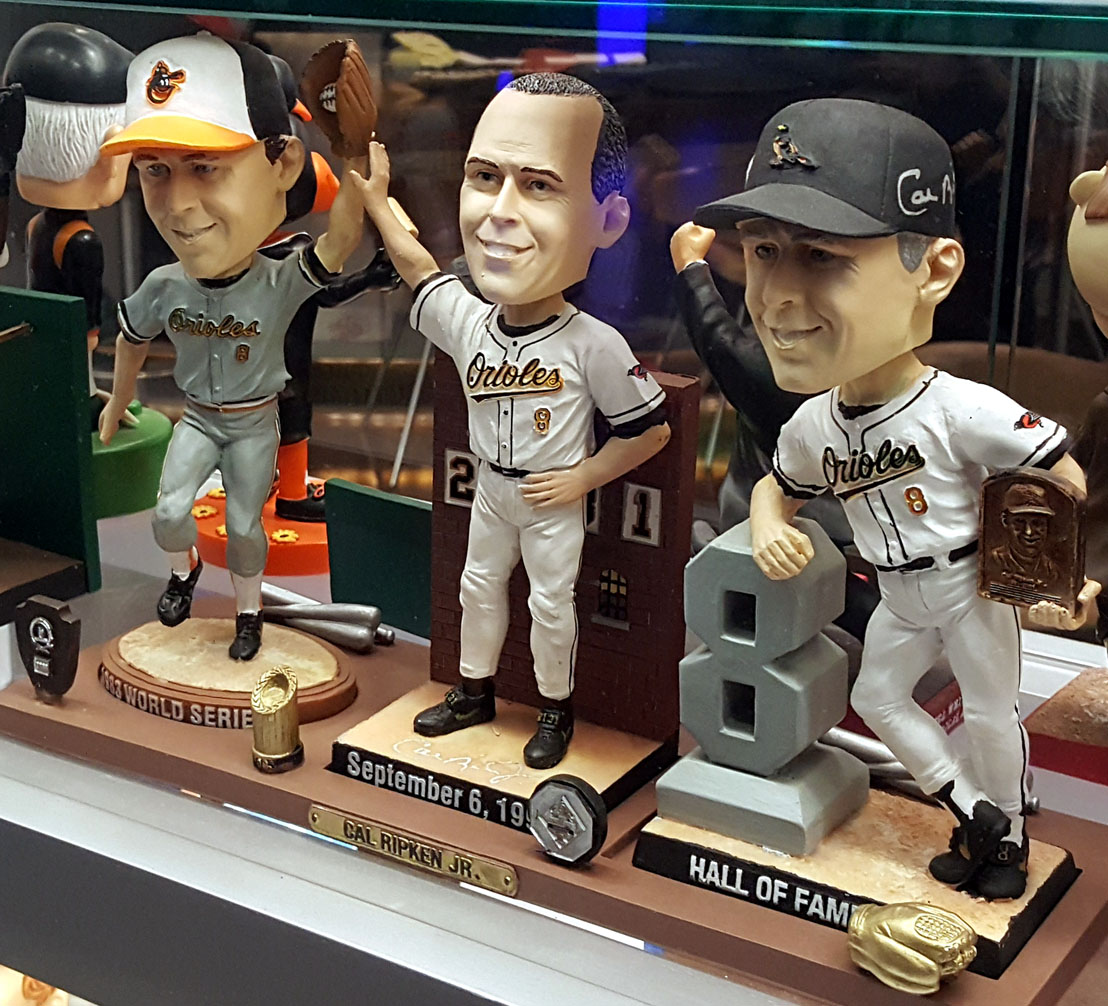
Baseball, you have not yet afforded me the opportunity to meet Cal Ripken, Jr., but I guess I will let that one slide since you did give me such good memories following his career during “The Streak” and beyond.

Sadly, not all of my encounters with the men who played you were as encouraging as meeting “The Earl of Baltimore.” Through my attempt to meet Frank Robinson, you taught me the valuable lesson that not everyone who wears your uniform is a hero to be looked up to.

While it is entirely possible that the outcome would have been different on another day, my attempt to meet Frank Robinson soured my opinion of the man, and taught me a valuable lesson in the dangers of heroes letting you down.
Photo R. Anderson

It was a hard lesson for me to learn at the time, but it has helped me separate talent for the game from being a hero off the field. It is possible to respect what a player can do on the field without expecting them to be perfect off the field.

There are of course players who shine both on the field and off, but you let me see that those people are exceptions to treasure, versus the rule.

My joy in you was not limited to just being in the Ballpark. I spent hours collecting your cards and trying to compile complete sets of them each year. I kept checklists in my wallet to know which cards I needed whenever I would find myself at a card shop. I even tried my hand a running a small card shop in my neighborhood for my friends. Grandstand Cards was my first business venture, but it was far from my last.

Every Saturday I rode my bike to the neighborhood 7-11 for powdered doughnuts, a Sunny-D, some baseball cards, and a comic book. Those were much simpler times. While I cherished those days at the time, I cherish them even more now.

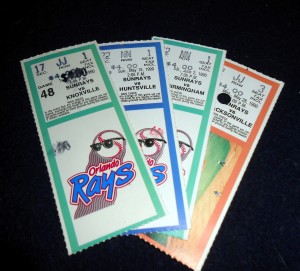
I still have those cards, as well as the team scrapbooks that I made for the Orlando Sun Rays and the Baltimore Orioles. Each time I pull them off the shelf the memories return, and I am transported back to those days of going to the local baseball card shop, and sitting in those well-worn grandstands at Tinker Field.

While I saw numerous Spring Training games at Tinker Field, it was Minor League Baseball that really grabbed my attention and stoked the desires of younger me to work in sports promotions at a ballpark.
Photo R. Anderson

While my three seasons of attempting to play you did not lead to All-Star numbers, you taught me that I could make a career out of telling your story through the various news outlets I worked for.

You even gave me the opportunity to have a full-ride scholarship as a collegiate baseball team manager, which a younger me turned down to go to a different school. It all worked out in the end, and to this day I can still legitimately say that I turned down a full-ride baseball scholarship. I just leave out the part about it not being as a player.

Then there was that 21-inning high school playoff game that I covered as a high school reporter at the old Baseball City Stadium. Man, I sure learned my lesson that night about not leaving the warmth of the press box before the final out. I spent 12 extra innings freezing behind the dugout while my colleagues mocked me from their warm perch.

Despite that unseasonably cold Florida night, and all the other nights shivering in your stands, you taught me that one of life’s simple pleasures is sitting in your Ballparks and getting caught up in the action. You also taught me to never write the lead to an article while the game is still going on, since very few leads are safe once teams are forced to go to the bullpen.

I also learned from you, Baseball, that whenever possible, get a seat in the Ballpark next to the scouts. The times I have been seated in the scout section at Spring Training and Minor League games, I have been entertained by hours of stories of baseball behind the curtains. Sadly, scouts are a dying breed as more and more of your teams are taking a strictly statistical look at how you are played, versus relying on gut feel.

Very little tops a day at the Ballpark.
Photo R. Anderson

Baseball, you have given me the chance to interview many coaches and players. Some of them gave thoughtful answers, while others allowed me to play cliché bingo.

One manager even trusted me enough to write my own quotes for what I thought he would say. To keep it real, I even included some clichés in his quotes. At the end of the season of covering his team, he invited me into his office and said that he had never sounded better than he did when I “quoted him.”

I have thought a lot lately about those post-game interviews under the unforgiving Florida and Texas sun, as well as the interview in the rain that killed my recorder right after I transcribed the quotes. On that day Baseball, you taught me to never rely solely on a recorder, but to write down quotes in real time as well.

Just when I think that you have run out of things to teach me, Baseball, you give me new lessons through this delay in the action brought about by COVID-19. Through the virus you have taught me that player strikes are not the only thing that can cause the games to stop, and that we should not take you for granted when you do return.

More importantly, Baseball, you have reminded us that there are more important things than you, and your other sport siblings. Taking care of ourselves and others is far more important, no matter how badly we want to throw caution to the wind and cram inside your hallowed halls and watch you “play ball” once again.

The Atlantic League of Professional Baseball was the first to use a pitch clock when the Sugar Land Skeeters and other teams implemented it as part of a test with Major League Baseball..
Photo R. Anderson

When you do return, Baseball, either this year, or next year, some people will no doubt continue to complain that your games are too long, that pitchers need to not take so long between pitches, and that umpires need a robotic voice in their head telling them how to call balls and strikes.

Ignore those people, Baseball, and try to resist the calls to constantly tinker with your game. Part of what makes you perfect are your perfect imperfections, and the fact that there is no game clock to say when the game ends.

Baseball, you will come back stronger, and will once again fill those summer nights with the sights, sounds and smells, of the National Pastime.

Hang in there Baseball, I know we will see each other again soon when it is safe to do so. Until then, thanks for the memories you have given me so far, and thanks in advance for the memories yet to come.

Now if you’ll excuse me, this trip down memory lane has me craving some powdered doughnuts and Sunny-D.

Sincerely yours,

Ryan

Copyright 2020 R. Anderson

Remembering our Heroes (Past and Present) on Memorial Day

Today is Memorial Day. I say that with confidence after checking a calendar to confirm my suspicions. Normally, I would have no trouble at all remembering that the last Monday of May is set aside as a day of remembrance, and a time to honor the men and women who died while serving in the United States Armed Forces.

However, in this newfound time when one day can just roll into the next and be called MonTueWedday, it never hurts to check a calendar for guidance as society charts new territory. This potential side effect of not knowing what day it is comes as much of the world is sheltering in place and honoring the calls to social distance as we unite as one in the battle against the COVID-19 virus which has killed nearly 100,000 Americans.

Large flags and camouflage hats mark Memorial Day across Major League Baseball each year.
Photo R. Anderson

In the past, Memorial Day weekend acted as the unofficial start to summer and involved packed beaches and an overabundance of sports to watch. The weekend also lent itself to copious amounts of meat to cook over an open flame.

While I enjoy baseball, beaches and barbecue, for me, the highlight of the extended Memorial Day weekend has always been as the announcer used to say “Sunday, Sunday Sunday.” I would awake before the sun to catch the Monaco Grand Prix, and then switch over to the Indianapolis 500 before ending my day of nonstop auto racing with the Coca Cola 600.

The times that I was not watching racing, I could catch numerous baseball games from coast to coast.

As a sign of unity during troubling times, the U.S. Navy’s Flight Demonstration Squadron, the Blue Angels, and the Air Force’s Air Demonstration Squadron, the Thunderbirds, flew over several U.S. cities to honor front line workers.
Photo R. Anderson

That all changed this year. Thanks to COIVD-19, the Monaco Grand Prix and the Indianapolis 500 were not run Memorial Day weekend.

The Coca Cola 600 did take place yesterday, but the stands were empty of the thousands of fans who usually soak in the action. Additionally, there is no joy in Mudville since baseball is still sidelined by the virus.

The NHL and the NBA suspended their seasons in March with no set timetable on when they will return to action. There will be increased drum beats in the coming weeks for sports to return. Leagues are hemorrhaging money and will want to try to recoup as much revenue as they can.

Owners will say that they are doing it for the fans, but many surveys have noted that a lot of sports fans will not feel comfortable heading to an event for a while. Athletes are also becoming more vocal in their opposition to returning to play until they can be assured that it is safe to do so.

So, it is on this Memorial Day that instead of rooting for one’s favorite team, the world has a common enemy to unite behind. The world is at its best when it works together, and there has perhaps been no greater battle than the one it currently finds itself in. Millions of Americans are working from home, alongside children who are learning from home.

Millions more Americans have lost their jobs and are questioning when things will return to the good old days known as before March 2020. It is entirely possible that the good old days as we knew them are years away from returning.

Veterans with underlying health conditions, and the Navajo Nation whose language was used as an unbreakable code in World War II are being hit especially hard by COVID-19, so it is fitting on this day of remembrance that we not only remember their sacrifice in time of war but that we pray for their safety in this battle against the virus.

The Los Angeles Memorial Coliseum was commissioned in 1921 as a memorial to veterans of World War I.
Photo R. Anderson

States are starting to ease restrictions on what people can do in an effort to spark the economy. There will no doubt be temptation to push the limits and go out and have as normal of a Memorial Day as possible, and just hope for the best in terms of avoiding infection from COVID-19.

Some politicians will call this the need for people to exercise pent up demand to get out and do normal things. Other politicians will call such actions reckless and an endangerment to others around them. Countries that have reopened early have seen their number of cases go up in some instances. There is no magic formula for deciding when to roll out a “Mission Accomplished” banner.

Throughout all of this, it is crucial to remember that the power resides with individuals to decide when they want to rejoin the economy. Just because something is open, it does not mean that people are forced to go there. COIVD-19 is a relentless scourge that takes no notice of a person’s sports affiliation, political leanings, or any other factors in its path of destruction.

Uncle Sam knew back in World War II that the world needed more moxie. While it may have been a soda slogan back then, today the need for moxie is stronger than ever as the world tries to fight a common public health enemy.
Photo R. Anderson

In past challenges that are remembered on Memorial Day, like World War II, citizens rallied to do all they could to defeat the common enemy.

My grandmother built battleships in Georgia, and my grandfather fought at Pearl Harbor, among other battle sites. My grandparents, and millions of other people’s grandparents, parents, brothers and sisters have done similar things when called to duty.

Memorial Day reminds us that Americans owe their freedom to the sacrifice made by countless individuals who came before us, and to the people who are currently serving in the armed forces. The sacrifice of those who came before us who we remember on Memorial Day made us who we are. Sacrifices people make now to contain the virus, is a gift we can leave for the generations that come after us.

The COVID-19 virus has shown us that a pair of scrubs, a retail vest, or an apron can be just as heroic as camo. Sports on Memorial Day will return, but this year on this day of remembrance instead of complaining about a lack of live sports, stop to think about the health care workers, the police officers, the fire fighters, the grocery store workers, the meat packers, the restaurant cooks, the warehouse fulfillment workers, the delivery drivers, and every other person across the globe who is doing their best to keep the world going.

Many of us are taught as kids that super heroes wear capes and masks. That is true, but the capes are invisible lest they get in the way of the work being done by the people on the front lines, and the masks are there to both protect the identify of the super hero, as well as to protect those around them. Lucky for us our modern day heroes are working on Memorial Day, and every other day keeping us safe from enemies seen and unseen.

Now if you’ll excuse me, I need to go pick up some groceries curbside and thank some front line workers.

Copyright 2020 R. Anderson

NASCAR Provides First Look at What the Return of Sports Could Look Like as Other Sports Sit Impatiently in Neutral

Brad Keselowski started on the pole on May 17, 2020 when NASCAR returned to live racing after a nearly two month hiatus.
photo R. Anderson

When the history books are written to describe the era of COVID-19, it is likely that yesterday, May 17, 2020, will be remembered as the day that sports returned to America.

Okay, to be fair, all sports did not return yesterday. Declaring the “all clear, come and play ball y’all” is likely months away from occurring. Factor in a return to wide open, stadium rockin’ sports as they were prior to March 2020, and some experts say that could be a year or more away.

Still, yesterday will be remembered as the day that NASCAR told their drivers to start their engines, and the fans to stay home and watch. It is easy to see how NASCAR was the first sport to draw up a game plan for a return to competition.

Kyle Busch is set to run seven races in 11 days in all three NASCAR series as part of the sport’s return to live competition.
photo R. Anderson

Drivers sit alone in their 3,000 plus pound octane 93 fueled chariots. So, even during rubbing and bump draftin’, social distancing can be maintained.

Throw in helmets, and protective gear for the pit crew members, and you have yourself a ready-made example of responsible sport in the COVID-19 era. At least that is how the plan is supposed to work.

While social distancing works in NASCAR, other sports leagues will find it harder to show that the athletes are separated by the recommended Center for Diseases Control (CDC) guidelines of six feet of separation. The next sport on the clock to try to return a fan-free viewing experience to the world is Major League Baseball.

Baseball has already returned in South Korea where the season opened in empty ballparks, followed by ballparks allowing up to 1,000 fans to attend from a safe social distance.

It is hard to imagine a scenario where Major League Baseball says the first 1,000 people to the ballpark are allowed inside. It is safer to say, that the only people sitting in the stands for the foreseeable future whenever baseball does return will be team employees.

While no exact timeline has been established for the return of baseball, when it does return it is likely that the pregame lineup exchange at home plate will be eliminated.
photo R. Anderson

I have said this before, and it bears repeating, I miss baseball. However, I do not miss baseball to the point that I want to see players, umpires, and other team personnel put at undue risk of exposure to a virus that currently has no cure just so I can have a few hours of live sports during my work from home time.

Blake Snell, the 2018 Cy Young Award-Winning pitcher for the Tampa Bay Rays, made waves when he commented on his Twitch channel last week that playing an abbreviated baseball season with a pay cut was not worth the risk to his health for future seasons. Based on estimates of the proposals being negotiated between MLB management and the player’s union, Snell would earn around $2.3 million instead of $7 million in salary for playing what would amount to at best an 82-game season.

To be fair, athletes risk injury every time they take the field. However, one can certainly argue that risking your pitching arm and needing to miss a season because you are recovering from Tommy John surgery is entirely different than risking your health because of a virus.

Snell’s candid assessment of needing to look at his life after this season, versus playing this year and risking his health, drew the usual round of negative comments with people calling him “entitled,” and that he should just “shut up and play.”

After Blake Snell drew criticism for voicing concerns about returning to play baseball, fellow All-Star Bryce Harper noted that Snell made public feelings that many players are pondering in private in regards to the risk of playing baseball too soon to their long-term health.
photo R. Anderson

A pair of All-Stars, in Bryce Harper and Nolan Arenado, came to Snell’s defense by noting that Snell went public with what many players are thinking in private related to needing to look long and hard at the risks associated with returning to play baseball this year.

As part of a return to the ballpark plan reported by ESPN, players and all other people involved in the games would be tested for the COVID-19 virus several times a week to allow any potential outbreak to be snuffed out at the source. Under the plan to mitigate the spread of the virus , according to the ESPN report, players, would also be banned by fist bumping, high fiving, and spitting.

However, it is unknown whether players will still be allowed to bang on trash cans in the dugout. Too soon Astros fans?

MLB is targeting a return to play in early July. It is highly likely that the return will feature fireworks and other festive celebrations as the “Boys of Summer” play the National Pastime once more. Any return to play scenario needs to allow players to choose whether they want to return, or if they are willing to forfeit their salary in order to focus on their health for future seasons.

MLB is targeting a return to play in early July. It is highly likely that the return will feature fireworks and other festive celebrations as the “Boys of Summer” play ball once more.
photo R. Anderson

Assuming that MLB does the right thing and allows players to choose to sit out the season, that creates the question of why not just wait until next year to play at all.

Can an 82-game season with some of the top players on each team choosing to not play really be considered legitimate?

Of course, the answer, as it usually does, centers on money. Even without fans in the stands team owners and broadcast networks can make money on games.

Another footnote in the year of COVID-19 history book should not only include the day live major sports returned with NASCAR, but should also include the day that the MLB potentially chose finances over safety. Of course, that financial risk versus personal risk calculus is being performed across the globe as multiple industries look to reopen in the middle of a pandemic.

Millionaire baseball players aren’t the only ones who will need to perform a risk trade when it comes to returning to work. Employers at all levels need to be sensitive to the concerns raised by workers, and where possible accommodations need to be made to protect both their health and their jobs.

I miss going to see Swatson and the rest of the Sugar Land Skeeters. I look forward to a time when I am once again watching them from inside the ballpark.
photo R. Anderson

I am eternally grateful to the men and women working at the grocery store who bring my order out to my car and allow me the opportunity to stay safely socially distanced. Too often, some elements of society look down on workers in retail, transportation, healthcare and hospitality.
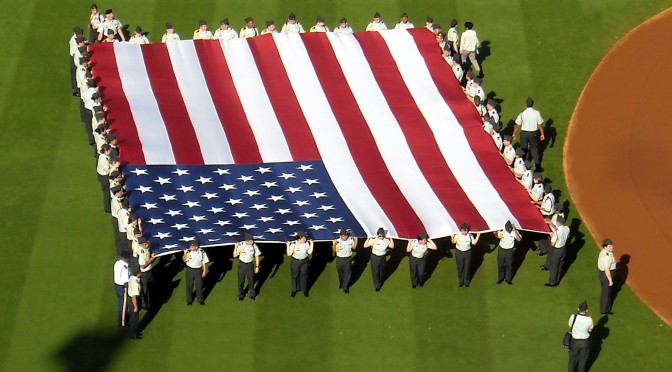
Society owes a huge debt to all of the people on the front lines. When the pandemic is over, the people who kept us safe, fed, and tended to health-wise, should be the first ones allowed inside the sporting venues as a show of thanks from a grateful nation.

Until then, sports leagues need to temper their enthusiasm for returning to play. We all miss sports. However, it would just take the death of one player to show that the risk was not worth it.

Now if you’ll excuse me, my work from home fury coworkers are meowing for some kibble.

Copyright 2020 R. Anderson