Category Archives: Beyond

Way back Wednesday: Remembering the Lost Art of the Postcard

Editor’s Note: I wrote this column on the lost art of sending postcards back in March 2013. During the current climate of COVID-19, as well as the attempt by some to disrupt the United States Postal Service’s mission to ensure that, “Neither snow nor rain nor heat nor gloom of night stays these couriers from the swift completion of their appointed rounds,” it seems appropriate to reflect on the connection people can feel through the mail.

It is also important to remember the old AT&T telephone jingle to “Reach out, reach out and touch someone,” during this time of COVID-19 to let people know you are thinking about them.

Of course, in the current COVID-19 climate, any reaching out should be done from a safe social distance. In the meantime, please enjoy this column as part of our occasional Way Back Wednesday feature.

In this age of instant messaging, e-mail, Twitter, and other ways to communicate at the speed of light, it may come as a shock to some of the younger readers that there was once a time when correspondence was not handled as quickly.

Before the days of Facebook, it was not possible to post a status while on vacation to all of your friends to let them know that you were “Having a great time exploring the world’s largest ball of twine.”

Instead, when you were at that ball of twine, and you wanted to let your friends know how much fun it was before seeing them again in person, you had to buy a postcard and actually place it in something called a mailbox. Your friends would than receive the postcard, and your thoughts on the ball of twine in a few days.

Yes, I know mailboxes still exist, and based on what comes in mine they tend to be a conduit for junk mail and bills alone.

As such I now only check my mail a couple times a month; since there really isn’t anything worth reading that would require me to check it any more frequently.

Once upon a time mailboxes served as a window to communicate with the world. Today, mine mostly serves as a place for junk mail and bills.
Photo R. Anderson

I have made a career out of writing. I was able to made the transition from writing for print publications, to writing for electronic platforms.

For the most part, writing is writing. There will always be a need for clear content to be communicated regardless of the changing platforms as technology moves forward.

While I know that the ways people communicate has changed, sometimes I find myself feeling a bit of nostalgia for the written word and the simple act of receiving a post card through the mail.

Part of this nostalgia was the result of looking through my postcard collection the other day to help remember the name of somewhere that I went on vacation many years ago.

I ended up finding that postcard and my memory was jogged. Looking through the box, other memories were set free as well.

Many of the postcards in my collection were sent to other family members before I was born and were just passed down to me; but several are actually addressed to me. One particular series of cards was the result of a chance encounter on an airplane.

When I was in third grade, my mom and I were on a flight from Washington D.C. to Orlando, FL. There was an older gentleman in the row with us (of course when I was that age everyone was older, so my memory of how old he really was may be warped).

As it was a relatively long flight, we ended up making conversation. Over the course of the conversation, he mentioned that he did a lot of traveling as part of his work with the Army.

I do not recall the whole scenario of how it occurred, but addresses were exchanged and he mentioned that he would write me from his travels.

The postcards did not always include a message but this is typical of the type of message when they did.

In this more jaded world that we find ourselves in now, the chances of a stranger getting the address of a young child under the guise of sending correspondence would probably be less likely to occur.

I for one have become way more suspicious of people’s intentions the older I get.

While it is certainly good to be skeptical, and careful of one’s surroundings, and those that enter them, I sometimes wish that I could see the world through younger me’s eyes when the world was a far less scary place. Back then, the only things I needed to worry about were which pair of pajamas to wear, and how many days until I could ride my bike to the 7-Eleven to check out the latest comic books, or buy a pack of baseball cards.

A few weeks after returning home, I got my first postcard from the man on the plane. The postcards continued for several years, and always included a short note about the destination included on the front.

One of the postcards my pen pal from the plane sent me.

The cards stopped one day, which could have been the result of many factors including the forwarding address feature no longer working, or perhaps the man behind them was no longer able to send the cards for whatever reason.

While I do not remember his name, I do remember the simple act of sharing postcards with a wide-eyed child and the effect that had and continues to have. I have no way of knowing if that man on the plane is even still with us.

If he is, I hope that he is well and is still able to take those wonderful trips that sparked my imagination so many years ago.

But those postcards, as well as the others I received from friends and family, helped me see parts of the world that were harder to see in the pre-internet days and certainly helped nurture my love of traveling.

Some 30 years later I still fondly recall the postcards from my pen pal. Tweets and e-mails will not hold up as well through the decades I imagine.

Today, thanks to the internet, if I want to see a picture of something I need only type it into a search bar and before long I will have more pictures to look at than I could ever hope for.

The Internet has opened the world up to us but in some ways it has also made us more alone than ever before.

I often think about other chance encounters and people who come into our lives for a brief moment and the impact that they have on us. Had my mom and I been seated in any other row on that airplane, I would not have received the postcards.

When I was in Journalism School, one semester my professor assigned the class a project to go to the food court at the mall and observe people. The point behind the assignment was to make note of the various interactions of people coming and going in order to imagine various scenarios as to what brought them there. To this day, I still enjoy people watching.

The next week, the same professor assigned us to go back to the same food court and find a stranger to interview. The point of the exercise being that everyone of us has a story to tell. The trick is to know the right questions to ask to get the ball rolling.

While the memory of the man on the plane will probably not make me any less cautious than I am, since the world today is so much different than it was all those decades ago it is still a nice memory and shows that we all do have stories to tell. The key is to just be open to hear them.

Now if you’ll excuse me, I think I am going to find a food court and see if my interview skills are still as sharp as they once were.

Copyright 2020 R Anderson


Hockey in the Summer is a Small Silver Lining in an Upside Down Sports Year

If anything can be said of the 2020 sports landscape, let it be said that 2020 has been a season like no other.

From fan-free stadiums and Ballparks, to playing sports in a bubble, sports fans are truly seeing things they likely never thought they would see. Of course, due to social distancing they are seeing it from a safe distance which most likely means from their couch.

One of the biggest treats I have discovered during this upside-down season is summer bubble hockey.

Normally I would be fully engaged in the Major League Baseball (MLB) season this time of year. However, thanks to COVID-19 taking a sledge hammer to the schedules of the major sports leagues, the National Hockey League (NHL) is fully engaged in the quest to crown a team worthy of hoisting Lord Stanley’s Cup meaning the “Boys of Winter” are now the “Boys of Summer,” at least for this season.

Washington Capitals Captain Alex Ovechkin is seeking his second Stanley Cup Finals victory. Unlike previous years, thanks to COVID-19 The Capitals and the rest of the Stanley Cup eligible teams are playing hockey during the summer while quarantined in either Toronto, or Edmonton.
Photo R. Anderson

To say that I am enjoying summer hockey would be the same type of understatement as saying that I enjoy breathing.

While breathing is a mostly automatic factor that I take for granted, I had no idea how much breath I would get out of four hockey games a day.

With teams safely quarantined in either Toronto, Ontario or Edmonton, Alberta, there are literally back to back to back to back hockey games on almost every day.

That is like a hat trick of hockey plus an overtime period. Or stated in a more Canadian way, it would be like ordering poutine and learning that the chef made too much, and, instead of throwing away the extra he is giving it to you at no extra cost.

The Vancouver Canucks have given their mascot, Fin, something to cheer about; albeit from a social distance and outside of the Edmonton bubble. The Canucks have a two games to one lead over the defending Stanley Cup Champion St. Louis Blues.
Photo R. Anderson

It should be said that I am totally sorry that it took a global pandemic to create summer hockey. COVID-19 is a horrible disease that I am ashamed to say the United States government has not done enough about.

Over 170,000 Americans have died from COVID-19 at the time of this writing. That is unacceptable. Each and every one of us should be holding our elected officials accountable for the way it was mismanaged.

Also, the rush to reopen schools, with zero coordinated effort, is already generating the type of results that anyone paying attention to the way germs spread could have told you would happen.

A week after returning to on campus classes, the University of North Carolina is shutting down in person learning and going back to online instruction due to outbreaks of COVID-19. Of course, UNC was quick to point out that even with students learning remotely have no fear the Tar Heels are still on track to play football in the fall, and travel from city to city with the Atlantic Coast Conference (ACC).

Unfortunately, instead of focusing on the important things, the bulk of the country has seemed to embrace a “let them eat cake” philosophy. Although instead of cake as the tone-deaf refrain, it is let them play football.

Playing hockey in two arenas where players are quarantined, is a completely different matter than allowing college football teams to go from town to town to bring people enjoyment on the weekend.

MLB has shown that playing outside of a bubble and traveling is a perfect recipe for catching and spreading COVID-19.

Stand up if you had summer Zamboni rides on your 2020 Bingo Card. Thanks to COVID-19 a winter sport is now a summer sport as the NHL seeks to crown a Stanley Cup Champion from inside the bubble.
Photo R. Anderson

Of course, the proponents of playing college football are likely to say that there is way less physical contact in football than there is in baseball. So the ability for the virus to spread won’t be as high, oh wait…

As I have said many times, I love college football. I would love to be watching college football when September rolls around. However, we are not in a position where that would be wise to do.

I also don’t see us magically getting the case count of COVID-19 to a low enough level in the next four weeks where playing college football is a wise thing to do.

Dr. Deborah Birx, the head of the White House Coronavirus Task Force, said that she wished that the United States had shut down and managed the virus in the same way that Italy did. Perhaps if the task force she is in charge of had made a stronger case for that, people would have listened.

Instead, America did a halfhearted shutdown before opening things wide open in time for Memorial Day. I mean why let a global pandemic get in the way of a three-day weekend, right?

As anyone who pays attention to how trends work could tell you, the levels of COVID-19 went up faster than a high stick in a hockey rink; and all of the gains made during the brief shutdown were lost.

Instead of a unified approach to the virus, some Americans wore masks and socially distanced, while others called the virus a hoax and said wearing a mask infringed on their civil liberties. Seriously?

When did doing what is right for the greater good become a political statement?

It looks like COVID-19 will continue to rage until there is a vaccine since some people cannot bring themselves to wear a mask. As a result, I will continue to enjoy bubble hockey from the safety of the Gigaplex.

I would love to be back out in the world doing the things I did before March of 2020. However, with around 1 in 4 people around here infected with COVID-19, and with so many unknowns about the long-term impacts of the disease, I am choosing to stay safe by limiting the number of things I do outside the Gigaplex. And when I do venture forth, I wear a mask and keep a safe social distance from those around me.

In Texas, very few people seem to be wearing masks. I guess they are still thinking they are immune. Either that, or they enjoy playing an extended game of Russian roulette. After all, I believe one of the conspiracy theories being spread on the misinformation superhighway is that wearing a mask takes away your Second Amendment rights.

That would be so worthy of a face palm, although as part of being COVID-19 aware we are not supposed to touch our faces. So, a virtual face palm will have to do.

The next NHL season is supposed to begin in October. Whether that season begins in two bubbles in Canada pretty much rests on what we do over the next two months to take COVID-19 seriously.

As much as I love bubble hockey in the summer, I really would like to attend sporting events in person again.

I am wearing a mask and doing my part to make that happen. What about you?

Now if you’ll excuse me, my Kraft Dinner is waiting.

Copyright 2020 R. Anderson

Five Tribune Newsrooms going Fully Remote as COVID-19 Continues to Impact the Newspaper Industry

Last week I noted that many journalists are working remotely from bookcase filled mini newsrooms as a result of COVID-19.

For some print journalists, those remote at home locations will turn into their permanent bureaus as some newspapers look to jettison their brick and mortar holdings in favor of an all remote workforce.

This week, Tribune Publishing announced that the physical offices of five newspapers it owns will be closed permanently in response to COVID-19, as well as a changing newspaper climate.

In making the announcement Tribune Publishing noted in a statement that, “Out of an abundance of caution we do not anticipate having employees that can work remotely coming back into the office for the remainder of the year and into 2021. With no clear path forward in terms of returning to work, and as the company evaluates its real estate needs in light of health and economic conditions brought about by the pandemic, we have made the difficult decision to permanently close these offices.”

The five newspapers going fully remote are the Daily News in New York City, The Capital Gazette in Annapolis, Maryland, the Orlando Sentinel in Orlando Florida, The Morning Call in Allentown, Pennsylvania, and the Carroll County Times in Maryland. The papers join a growing list of newspapers that are rethinking their business model.

At a time when solid journalism is needed more than ever to bring facts to the masses and debunk false claims from people in power, more than 50 local newsrooms in the United States have closed since the start of the COVID-19 pandemic, according to the journalism think tank the Poynter Institute.

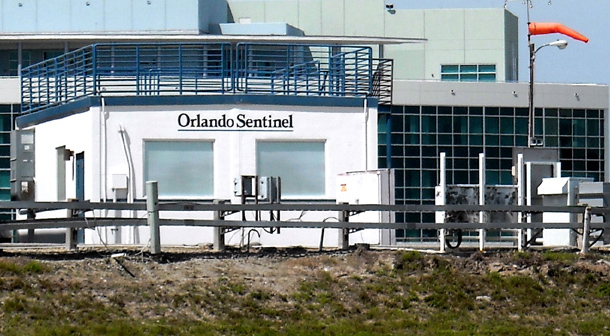
For years the Orlando Sentinel has had a remote newsroom at Kennedy Space Center’s Press Site. With the announcement that the Sentinel’s parent company is moving out of the main headquarters, one has to wonder whether a move out of remote bureaus like the one at KSC can be far behind.
Photo R. Anderson

Additionally, a UNC Hussman School of Journalism and Media report discovered that, “since 2004, the United States has lost one-fourth, or 2100, of its newspapers.”

The study went on to state that these resulting “news deserts” mean that “more than 200 of the nation’s 3,143 counties and equivalents now have no newspaper and no alternative source of credible and comprehensive information on critical issues.”

Consider that fact as people try to figure out whether schools are safe enough to send their kids back to, or if the COVID-19 virus is getting corralled, or is still raging out of control.

Granted, there are still television networks and online news sources to fill some of the void, but for many people the local newspaper is their lifeblood for getting the news that matters to them.

The newspaper industry is far from the only business segment that is likely to consider the cost benefits of shedding their real estate holdings in favor of a remote workforce. However, the announcement that newsrooms would be closing permanently hit me particularly hard.

I grew up reading the Orlando Sentinel, and at one point thought I might work there. Although to be fair, I totally preferred reading Florida Today and the Tampa Tribune over the Orlando Sentinel.

Still, the Sentinel building was a beacon of First Amendment freedom whenever I would drive by it. It was empowering to think of all of the journalists inside those walls working hard night in, and night out, to deliver the truth.

When I was growing up my dream journalism job was to be on the space beat for Florida Today and work out of their press site at KSC. In 2015, the building that I had wanted to work at for so long no longer bore the newspaper’s name on it.
Photo R. Anderson

I even worked with, and competed against, many of the members of the Sentinel’s Sports Staff in my years covering high school and college athletics in and around Orlando.

So although I was never an employee of the Sentinel, I knew many people who were, and still are.

The mighty offset presses inside the Sentinel building went silent about three years ago. Like many papers, the Sentinel outsourced their printing to third parties as a way to cut costs. For the Sentinel, that meant a switch to a printing press about an hour away from downtown Orlando.

I know that the heart of a newsroom is made up of people, and not a building. However, it was the proximity of the people in that building that created the buzz and collaboration that makes journalism work.

When I was 16-years-old, I got my first professional newspaper job as a sports stringer for the Sanford Herald. For an aspiring journalist such as myself, the Herald newsroom was like walking into Willy Wonka’s Chocolate Factory without all of the chocolate and the singing.

Most of the reporters had already gone home by the time I got to the newsroom to write my stories, but the building was still alive with the sports staff, the photographer, and the team that ran the presses.

All these years later, I can still picture the cluttered desk of my first editor and the stacks of paper and other things that he had accumulated through the years surrounding it.

Looking around the cluttered desk I am sitting at while writing this, I suppose I subconsciously picked up that trait.

Aside from memories of cluttered desks stacked high with newspapers, I can still close my eyes and smell the unmistakable odor of newsprint and ink that filled the air. If the First Amendment was a cologne, to me it would smell like newsprint and ink.

The hands-on instruction I received from at the Herald proved invaluable to me in my writing career. Aside from learning the craft of writing on deadline, thanks to those Friday nights in the newsroom I also cannot listen to Edie Brickell & New Bohemians without thinking of the deep thought meditation quote taped on the wall above the editor’s computer.

Through my own years as an editor, from press box to press box, and newsroom to newsroom, I have sought to impart knowledge the same way to the reporters and other people I have managed as the way it was imparted to me all those years ago in a dusty and cramped newsroom in Sanford, Florida.

While I am all for the ability to file stories from the press box to avoid a long cross county drive back to the newsroom, there are definitely times when meeting face to face in a newsroom is critical to honing one’s craft.

It is hard to think of remote video calls having the same impact as actually seeing one’s colleagues face to face.

Of course, I realize that sounds somewhat hypocritical of me to say since I have been basically working remotely for years, and have loved every minute of it.

If the rate of newspaper closures continues at the current pace, it is quite possible that soon the only newspaper boxes one sees will be in Christmas villages and old movies about the glory days of print journalism.
Photo R. Anderson

Still, it is different to work from home and know there is an office to go to from time to time, versus having the office sold and knowing that working from home is the only option.

When I first heard the news of the Sentinel closing their offices, I did what any good reporter would do and researched whether any of the newsrooms I had worked in were still in the same buildings that they were when I worked there.

I already knew that one of the newsrooms I worked in was gone. That newspaper merged with another paper and closed. As a result, I was laid off since the merger made me a redundant employee.

The paper I worked at before the one that merged is still in their same building. That led me to dig deeper and explore the weekly newspapers I worked for at another community chain.

Much to my surprise the entire 20 newspaper chain went from having newsrooms in each of the communities it served, to having one office and half the staff. They also sold the building that had the only printing press in the chain and joined the outsourcing trend.

That brought me back to the Herald, where my professional newspaper career began. Like so many of the other papers I had worked for, the Herald also left their long time building for a smaller facility that did not have a printing press attached to it.

The results of my research revealed that only one of the six newsrooms I worked in is still in operation at the same location it was in when I worked there.

The consolidation of the newspaper industry, and the media in general, will have long lasting effects on the ability to deliver impactful stories that make a difference in communities both small and large.

I know I am biased towards the need for a free and independent press to perform the duty of the Fourth Estate and hold leaders accountable, while also printing the scores of the local youth sports leagues.

COVID-19 has taught us that the need for clear and honest journalism is needed now more than ever. Unfortunately, with so many local newsrooms counting on funding from local businesses to operate, many more newsrooms are likely to go dark in the weeks, months and years to come as advertising revenue shrinks.

I can take solace in the fact that although Tribune Publishing closed five newsrooms, they did not fully shutter the newspapers altogether. Unfortunately, not all newspapers will be as lucky.

COVID-19 did not create all of the funding issues for local print journalism, but it definitely didn’t help slow the spread of the demise of independent voices.

Now if you’ll excuse me, in honor of that quote on the wall in the first newsroom I worked in, I am off to ponder whether what I am is what I am, and whether you are what you are or what.

Copyright 2020 R. Anderson

Dinosaurs can Teach Us a Lot About Sports and Pandemic Response

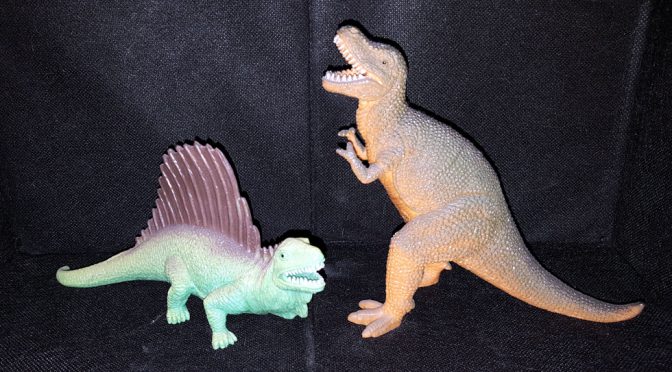
Like many other kids, when I was growing up, I loved dinosaurs.

Show me a picture of a dinosaur and I could tell you the name of the species in question, as well as whether it was a plant loving herbivore, or a meat loving carnivore.

Although my favorite dinosaurs were the Stegosaurus and the Triceratops, I celebrated the entire catalog when it came to the world of dinosaurs.

Although my favorite dinosaurs were the Stegosaurus and the Triceratops, I celebrated the entire catalog when it came to the world of dinosaurs.
Photo R. Anderson

In turns out that my fascination with dinosaurs was not limited to my youth.

I recently completed an online course called Dino 101: Dinosaur Paleobiology, that was offered by the University of Alberta. If the course taught me anything, it is that I still like dinosaurs as much as I did growing up.

It also taught me that a lot has changed in dino science since I was a kid.

So, why do I bring up dinosaurs you may ask?

As we all know, dinosaurs are no longer with us. While scientists may argue about the specifics of how it happened, they all agree that except for fantasies portrayed in cinematic parks of a Jurassic nature, dinosaurs are very much extinct in this day and age.

That got me thinking about the ongoing debates related to the wisdom of playing sports in the middle of the global COVID-19 pandemic.

As we all know, dinosaurs are no longer with us. While scientists may argue about the specifics of how it happened, they all agree that except for fantasies portrayed in cinematic parks of a Jurassic nature, dinosaurs are very much extinct in this day and age.
Photo R. Anderson

Thankfully, we are likely to have a vaccine, therapeutic treatments, or at the worst herd immunity against COVID-19 before things would reach an extinction event level scenario.

However, the fact remains some people are ignoring the virus, and trying to act as if there isn’t a huge asteroid heading towards them.

Major League Baseball (MLB) ignored the science, and is paying the price through player and staff outbreaks in their non bubble approach to the season. Recently, it was noted that MLB may look into a modified bubble approach for the postseason.

The NHL and NBA are just two of the leagues that have shown bubbles work. The MLB and the rest of society could learn a lot from their example.

Of course, despite the growing evidence, and the growing COVID-19 outbreak, some sports are appearing to be as dense as a dinosaurs armor plating when it comes to evolving their thought process on the reality of the disease.

Consider the world of college football as the next battleground in the “to play or not to play” debate. While some college football conferences are canceling their fall seasons, there are others that are either waiting until the last possible minute to cancel, or are somewhat convinced that a miracle will occur and the heavens will open up to allow them to play football.

Of course, despite the growing evidence, and the growing COVID-19 outbreak, some sports are appearing to be as dense as a dinosaurs armor plating when it comes to evolving their thought process on the reality of the disease.
Photo R. Anderson

Don’t get me wrong, I enjoy football. I especially enjoy college football.

As mentioned previously, one of my favorite things to do on Saturdays in the fall is to get up and watch College GameDay followed by watching football games until late into the night.

The idea of a fall without football is certainly a tough thing for me to consider, but as the late Wilfred Brimley would say when he was selling oatmeal on TV, canceling college football is “the right thing to do.”

To be clear, football, even limited conference schedule only football, has no business being played in the middle of a global pandemic.

Of course, since college football is more business than educational endeavor, that is exactly the argument being made for why college football must be played.

Put bluntly, the argument for why some schools are determined to play is because there is too much money involved to just walk away.

Lost in all of the noise about needing to play college football in order to make all of that sweet, sweet cash, is the fact that college athletes are not paid. Also, college athletes do not have the same protections as professional athletes when it comes to negotiating their rights to opt out of the season without penalty.

Talk about a prehistoric concept.

I spent several years of my career working in collegiate sports information offices. As such, I have a bit of an idea of the inner workings of a college athletic department.

When the COVID-19 pandemic began to surge like a tidal wave heading towards an unsuspecting beach, my first thought was there is no way that any college athletics program will want to risk the lives of their students just to make a few bucks.

Yes, there are college athletes who want to play football. However, there are also athletes who are worried that playing football this season will result in long-term health effects, or even death. I figured the adults in the room would choose athlete safety over profit.

Oh, how wrong I was.

Although some conferences have done the right thing and delayed and/or cancelled their seasons, The Big 12 and Southeastern Conferences (SEC) are promoting an “ignore the rising death count, we are here to play ball” approach.

It is likely not a coincidence that the Big 12 and SEC schools are mostly located in cities and states that are treating COVID-19 like a hoax. Many people in those areas are refusing to wear masks, or social distance and are promoting wild conspiracy theories that might even make the writers of the X-Files say, “That’s some crazy stuff right there.”

Perhaps if the athletic departments at those schools left their multimillion dollar facilities and walked to the science departments on the other side of campus, they might get a better idea of why playing football in the middle of COVID-19 is not really a good idea.

The sad thing is, that if everyone had just buckled down in March and not prematurely reopened for Memorial Day the spread of COVID-19 would likely be contained to a level where playing college sports could be handled safely.

Perhaps if the athletic departments at those schools left their multimillion dollar facilities and walked to the science departments on the other side of campus, they might get a better idea of why playing football in the middle of COVID-19 is not really a good idea.
Photo R. Anderson

Of course, that is not what happened, and so we are worse off now than we were back in March.

Going back to our dinosaur example, some scientists have hypothesized that had the asteroid that hit near the Yucatan Peninsula, resulting in the death of 75 percent of the earth’s species, hit almost anywhere else on the planet the dinosaurs likely would have survived.

While we can’t bring back the dinosaurs, it isn’t too late to get a handle on containing COVID-19. That is where the focus should be. We should not be worrying about what to do on Saturdays if there is no college football to watch.

The Chicxulub asteroid didn’t stop to ask the dinosaurs what they ate. It wiped out both the herbivores, and the carnivores with equal reckless abandon.

Likewise, COVID-19 attacks the people in blue states, as well as the people in red states.

Or, to put it in college football terms, COIVD-19 doesn’t care if you want the Tide to roll, or if you think that it is time for someone else to build a dynasty on the gridiron.

There will be a time to play college spots again, but first we really should get the raging wildfire under control. That should be something that even the most bitter of college rivals can agree on.

Now if you’ll excuse me, I am off to see if I can extract some DNA from this mosquito I found in a block of amber.

Copyright 2020 R. Anderson

Due to Writer’s Block Today’s Column has been Cancelled

Dating back to the first article I wrote for my middle school newspaper, I have spent the better part of three decades as a journalist.

During that time, I have spent many hours inside bustling newsrooms pounding out columns and other articles at deadline. I even lived every print journalist’s dream and got to yell, “stop the presses” once when I was working as a sports editor at a daily newspaper.

Okay, it was more like, “Hey, Bob we need to redo the front page, so can you stand down for a bit?”

But in my mind, I ran in there like Michael Keaton in The Paper with Glenn Close chasing behind me trying to stop me from bringing those mighty offset presses to a halt by pressing the kill switch like a crazed Guttenberg.

For the record, that would be like a crazed Johannes Gutenberg, and not like a Police Academy alum Steve Guttenberg.

There is an electricity in newsrooms that is hard to duplicate. So it is that lack of electrical energy that I will blame for my malaise when it came to deciding what I wanted to write about today.

I certainly tried to think of something clever to write. Instead, I spent most of the day staring at a blank computer screen when I wasn’t making homemade tacos, or blueberry pancakes, while watching documentaries and flipping between baseball and hockey games.

So, it is with my sincere apologies that I must announce that today’s column has been canceled due to a lack of subject to write about.

Sure, I could write about the fact that COVID-19 cases continuing to soar out of control like a bus being driven by Sandra Bullock on a deserted California interstate.

I certainly tried to think of something clever to write. Instead, I spent most of the day staring at a blank computer screen when I wasn’t making homemade tacos, or blueberry pancakes, while watching documentaries and flipping between baseball and hockey games.
Photo R. Anderson

If I were to write about that, I would be sure to point out that at the time of this writing over 162,000 Americans have died from COVID-19 as the virus continues to speed along killing about 1,000 people a day without showing any real sign of stopping.

I would also be sure to point out that more and more students and teachers are raising concerns about the patchwork of rules being implemented for returning kids to school.

Many schools seem to be treating back to school like some sort of demented science fair project where the students left standing get ribbons, and the rest of the students and staff risk long-term health effects that could dog them for the rest of their lives.

But hey, just open it all up and hope that fortune favors those who fail to follow the science. Spoilers, it doesn’t.

I could write about that, but it would be too easy to say that cases of COVID-19 are rising because of a lack of a central plan to combat the virus, and that nationwide testing needs to be increased in order to fully get a grasp on the virus before trying to reintroduce people to large indoor spaces like schools and whatnot.

Were I writing about concerns pertaining to back to school, I would also be sure to point out that despite what you may have heard, kids can catch and spread COVID-19 as well as adults.

If I was so inclined, I could even write about how instead of tackling real issues about how to encourage people to take the virus seriously, the President of the United States is holding press conferences where members of the public are not abiding by the few guidelines his administration has actually given out regarding COVID-19. You know that whole wear a mask, stay six feet apart, and avoid large indoor gatherings thing to stop the spread.

No, that would be too easy to write about.

Oh, I suppose I could even write about the expected 250,000 people heading to South Dakota this weekend for the largest gathering that has taken place since the start of the COVID-19 pandemic.

But if I were to write about it, no doubt I would point out that it will be interesting to see whether cases spike across the country as a result of the large gathering that 60 percent of the locals in the community asked be cancelled out of concerns for their health.

It seems like every day we plunge further down the rabbit hole. Meanwhile, our elected officials stick their heads in the sand like ostriches clicking their heels together and trying to just wish the virus away.

I could even write about how much enjoyment watching three bubble hockey games a day is giving me. But that would be unfair to Major League Baseball (MLB) to point out that bubbles work and trying to play ball outside a bubble leads to COVID-19 outbreaks.

You know, like the current outbreak that has caused a weekend series against the St. Louis Cardinals and the Chicago Cubs to be cancelled.

Oh, I’m sorry, I forgot MLB refuses to use the word cancelled. Let me try again, a series against the St. Louis Cardinals and the Chicago Cubs that was postponed to some future date.

While I am in no way going to write about the Cardinals, if I were to write about their situation, I would likely point out that with the latest series “postponement,” the Cardinals will have gone at least 12 days without playing a game.

While I am in no way going to write about the Cardinals, if I were to write about their situation, I would likely point out that with the latest series “postponement,” the Cardinals will have gone at least 12 days without playing a game.
Photo R. Anderson

Thanks to two COVID-19 flareups, with nine players and seven staff members testing positive for the virus, the Cardinals have only played five games this season.

Assuming they are given the all clear to resume play on Monday, they will face the task of needing to play 55 games in 49 days just to complete their 2020 season.

To be totally clear, I won’t write about the uphill climb faced by the Cardinals. But if I did, I would once again have to point out the total lunacy of MLB’s tunnel vision of playing a 2020 season despite the risks, and despite having multiple teams unable to compete. If MLB is not careful, sudden death will take on a whole new meaning this season.

I could even write about the foolish push to try to play football in the fall were I so inclined. Were I to tackle that issue, pun intended, I would be sure to note that if we were able to get the infection rate down to a manageable level than perhaps playing football would be a nice reward for a functional society.

But, plateauing at 1,000 people dying a day does not really sound like something to celebrate by tossing the old pigskin around.

Some college football conferences as well as some individual teams have agreed that playing football in the middle of a global pandemic is not smart. As a result, they cancelled their 2020 seasons. Time will tell if others follow suit.

So, with nothing to write about today, I guess I will just have to go back to trying new recipes for poutine as I continue to watch the quest for Lord Stanley’s Cup.

Now if you’ll excuse me, I am off to ponder what I will write about Monday.

Copyright 2020 R. Anderson

COVID-19 is Changing Where Journalists Work, but Not Why They Work

Thanks to COVID-19, although many professional sports leagues have resumed play, in many cases the broadcasters are calling the game action from miles away.

For NASCAR, only the pit reporters are live on the scene. The announcers are calling the action from Charlotte, North Carolina.

Ditto for Major League Baseball where national broadcasters are in remote studios watching the game on a monitor just like the fans.

The ability to call games in real-time from remote locations is both a testament to the technology as well as a reminder that we are not in normal times.

During the time of COVID-19 many journalists have been broadcasting from their kitchens using plants and fruit as props. I can neither confirm nor deny that I grew this onion specifically for that purpose
Photo R. Anderson

Throughout my career as a journalist, I have interviewed people in person, and I have interviewed people remotely. The bulk of my story assignments involved actually being at the game, or the city council meeting, to get a first hand eyewitness account of the action.

Each rule begets exceptions, so while I always tried to be as they say “in the room where it happened,” there were times when a coach would call me with results of an out of town ballgame to ensure it was covered.

Although, I would often write stories at my desk after a game, never once did I think, “You know what, I think I will just cover the whole game from right here.” Come to think of it, I wrote an award-winning story about a distemper outbreak without ever leaving my desk, so maybe there is something to be said for passive reporting.

After being mostly confined to the Gigaplex for the past five months, I can see a certain appeal to working from home, and consider myself extremely lucky to be able to do that.

I am far from the only journalist who has found themselves home bound, and having to modify their reporting techniques to include more WebEx interviews and video calls. Thanks to COVID-19, not only are journalists needing to change how they gather facts for a story, we are now getting an inside look at where those facts are being gathered.

As a result of the broadcast from home trend, where live from the studio, becomes live from fill in the blank, I have now seen Dan Rather’s study, and Bob Costas’ kitchen.

Growing up, I had always envisioned I would see those two places as an invited guest. In my mind, Dan, Bob, and I would be potluck pals as they bestowed their vast wisdom on a much younger colleague. Sadly, that dream has yet to come true but hope springs eternal.

Bob and Dan are far from the only people who have let viewers into their homes. For a while, the late-night talk shows of Jimmy Fallon, Conan O’Brien, Steven Colbert, Seth Myers and Jimmy Kimmel were filmed from their respective homes.

A few weeks back I started to ponder what my background would be if I got the call to provide my insight on a national television outlet, or, you know, if Dan Rather and Bob Costas invited me to a virtual potluck.
Photo R. Anderson

While I hate that it took a pandemic for it to happen, I have enjoyed the peek inside the homes of journalists, and other people on television.

A personal favorite viewing experience was the one night that Anderson Cooper broadcast his show from what looked like a rich mahogany study one would find in the pages of Agatha Christie, or Sir Arthur Conan Doyle. The only thing missing was a smoking jacket and the need for either Sherlock Holmes or Hercule Poirot to solve a whodunit case.

Anderson Cooper’s awesome (Gigaplex goals) home studio aside, the backgrounds for most people seem to fall under some main categories.

There are the shots of people in their dens in front of a wall of books.

There are people broadcasting from their kitchens with either flowers or bowls of fruit as props behind them.

There are even some people who utilize both flowers and fruit.

Another popular background is a roaring fire.

And of course, who can forget the wall of accomplishments, or a subtlety placed Emmy award casually shining in the background technique?

With so many backgrounds to choose from, and lots of time on my hands, a few weeks back I started to ponder what my background would be if I got the call to provide my insight on a national television outlet, or, you know, if Dan, Bob and I decide to have a virtual potluck.

The fireplace background technique was immediately eliminated. While there is a fireplace in the Gigaplex, I have never used it. In Texas it is hardly ever “fireplace weather.”

The “oh hey there, I am just chilling here in my kitchen with a pineapple while my sourdough starter rests” approach was also ruled out since as much as I love a good still life, a) the Gigaplex kitchen is on the smaller side, b) really, a kitchen? and c) I do not have a pineapple, or sunflowers handy.

While I hate that it took a pandemic for it to happen, I have enjoyed the peek inside the homes of journalists and other people on television. It inspired me to look at what my own background style would be. I call this example, space is messy.
Photo R. Anderson

So, that led me to hone in on the wall of books background idea. When I was growing up, my parents had a den that had floor to ceiling bookshelves on two walls and rough cedar planks on the other two walls.

To this day, one of my biggest Gigaplex goals is recreating that room. Although, after seeing Anderson Cooper’s den I may need to up my game.

While I do not yet have a single room for all of my books, I do have several walls in several rooms filled with bookshelves. So, the key became deciding which wall to use as my base of broadcasting operations.

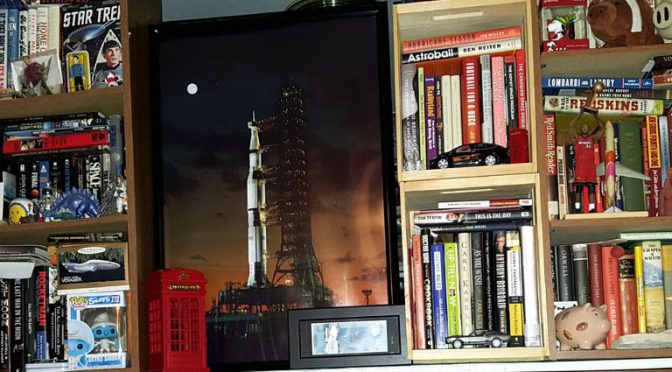
There are two types of wall of book displays that have been featured during pandemic protocol. There are the anal-retentive displays where the books are likely alphabetized, and arranged by color, size, or other design element. The second type is the messy lived in book look.

There are two types of wall of book displays that have been featured during pandemic protocol. There are the anal-retentive displays where the books are likely alphabetized and arranged by color, size, or other design element. The second type is the messy lived in book look. My design style is lived in and messy
Photo R. Anderson

Here at the Gigaplex I totally embrace the messy book approach. So, as part of my background experiment I set a ground rule that the bookshelf would be unmodified to reflect the true reality, versus spending hours arranging certain books so that they looked casually asunder, and not like they had been placed there on purpose.

Of course, with my books arranged by subject in various rooms, the trick became what type of book would I highlight?

Part of the fun of the book background is pausing the television and trying to read the titles of the books to see what other people are reading. One reporter’s book shelf even inspired me to order one of the books I saw.

My choices for book background were narrowed down to space books, sports books, and history/political science books. I left out my shelf of journalism books for the most part based on the bookshelf location. I also ruled out the book shelves of mysteries, science fiction, Ian Fleming, and pretty much all fiction books.

It is not that I am ashamed for people to see which books I have in those categories, it is just that those book shelves are located in the Gigaplex sleeping chamber.

The Gigaplex sleeping chamber was ground ruled out as a suitable background room based on poor lighting and the fact that I really don’t like to make my bed. Although I have seen a few people reporting live from their bedrooms.

So, with the criteria set for the bookish background photo shoot I went from shelf to shelf trying to decide which one would look best.

Ultimately, I decided that I could use two locations depending on which topic I was being asked to speak about. For sports related topics, I would go with my sports book background to show my vast knowledge of sport.

For harder hitting stories, my space books background would be chosen in order to give off that certain sumpin sumpin.

So, now that I know what background to use, I guess I will just go back to waiting for that call from a colleague needing my unique take on the news of the day.

Of course, I could also use the background for the podcast I am developing, but that is a story for another day.

COVID-19 has caused journalists to change how they gather and report the news in many cases. It has not however, changed the commitment to getting the facts out where they are needed; even if that means reporting from their kitchen in front of some sunflowers and a pineapple like a 21st century Vincent van Gogh.

Now if you’ll excuse me, I have some books to dust and I need to pick a dish to bring to the potluck with Dan and Bob.

Copyright 2020 R. Anderson

Washington Redskins Announce Name Change Without Announcing New Name

A week after celebrating their 88th birthday, the Washington Redskins are the ones giving out gifts by announcing that they ended their battle to maintain a nick name that a growing portion of society could no longer support.

While Native American groups had long called for the name of the franchise to be changed in order to remove what they considered a racial slur, ultimately it was the role of corporate partners threatening to withhold millions of dollars that moved the team kicking and screaming into the 21st Century.

Washington Redskins owner Dan Snyder, who bought the team in 1999, famously told a reporter from USA Today back in 2013 that he would “NEVER” change the name of the team that he grew up rooting for, and became owner of. The full quote by Snyder being, “We’ll never change the name. It’s that simple. NEVER — you can use caps.”

A week after turning 88-years-old, the Washington Redskins announced that they were changing their name and logo.
Photo R. Anderson

A week after announcing the team would form a committee to look into changing the name, “Never” became, we are changing the name.

The ball started rolling when FedEx, which pays millions of dollars a year to put their name on the stadium the Redskins use, called for a new name for the team.

The all-out blitz continued when several companies took things a step further and stopped selling Redskins merchandise. Amazon, Walmart, Target, Nike and Dick’s Sporting Goods, all removed Redskins merchandise from their websites last week. Nothing spurs change quite like a threat to the old wallet.

The new name was not announced during the press conference called to announce that the name would be changing. That is kind of like someone calling you to tell you that they sent you an email. Back in my Public Relations days, I would never have called a press conference just to give partial information. Oh, how times have changed.

To be fair to the Redskins, they did not announce the new name due to the need to secure trademarks for the new name before someone else tries to beat them to the trademark office. Back when there were rumblings about the team changing their name seven years ago, a Virginia man trademarked all of the potential names he could think of for the new team. Based on that ingenuity, they might as well call the team the Washington Capitalists.

Although a new name was not announced, the fact that a new name was coming was enough for Navajo Nation President Jonathan Nez to release a statement stating that, “July 13, 2020 is now a historic day for all Indigenous peoples around the world as the NFL Washington-based team officially announced the retirement of the racist and disparaging “Redskins” team name and logo. This change did not come about willingly by the team’s owners, but by the mounting pressure and advocacy of Indigenous peoples such as Amanda Blackhorse, and many other warriors who fought long and hard for this change.”

The statement by President Nez went on to say that, “We strongly encourage the NFL Washington organization to rename their team in such a way that truly honors and respects the First Americans of this country. Renaming the team “Code Talkers” to honor the Navajo Code Talkers, and other tribal nations who used their sacred language to help win World War II, would set the team on a path to restoring its reputation and correcting the historical misrepresentation of Indigenous peoples.”

The same week that the Redskins announced they were changing their name, the Atlanta Braves announced that they had no intention of changing their team name, but would look into the possibility of doing away with the “Tomahawk Chop.”
Photo R. Anderson

The same week that the Redskins announced they were changing their name, the Atlanta Braves announced that they had no intention of changing their team name, but would look into the possibility of doing away with the “Tomahawk Chop.”

The Cleveland Indians and Kansas City Chiefs are also facing increased pressure to change their names.

As I have noted before, I have rooted for the Redskins for as long as I can remember. My mom roots for the Redskins. My aunts and uncles root for the Redskins. For us, rooting for the Redskins through times of feast and famine was just what we did.

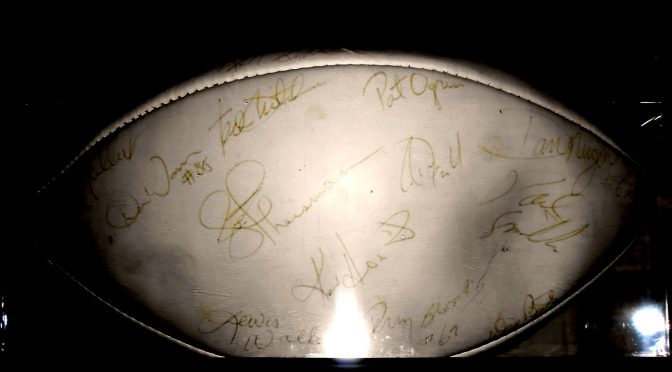
I follow other teams, but the Redskins were the first team I ever rooted for, and are the ones that hold the biggest place in my heart. In fact, here in the Gigaplex, there are at least 18 Washington Redskins related items on display that I collected over the course of my fandom.

Honestly, I would be lying if I said that a piece of my heart wasn’t broken based on the pending name change. Don’t get me wrong, I know that changing the name is the right thing to do, but as a lifelong fan, I have a little more skin in the game. Although I knew for years that the band aid needed to get ripped off, it still hurts.

As part of the end of the Washington Redskins era, I will need to decide whether I can keep my pieces of Redskin memorabilia on display to remind me of all of the memories I had, or if they should be taken down and placed in a crate and stored in a vast warehouse like the Ark of the Covenant in Raiders of the Lost Ark, never to be seen again.

This door knob decoration has been on a door in all of my bedrooms since I was in elementary school. With the Washington Redskins changing their name to be more inline with the times, the door decoration’s days may be numbered.
Photo R. Anderson

There will be a lot of soul searching between now and whenever the NFL returns again. In a way it is good that the idea of the NFL having a 2020 season is likely a pipe dream based on the current COVID-19 climate and the total lack of social distancing that comes with playing football.

By not having a 2020 season, fans of the team with the new name in Washington D.C. can have a year to mourn the death of the Redskins, and try to decide whether or not they will be on board with whatever the team becomes.

To be clear, as long as the COVID-19 pandemic continues to turn America into the laughing stock of the world as it runs free through the country like a tourist with a FastPass at Walt Disney World, any thoughts of kicking off a 2020 NFL season in September belong in Fantasyland.

Seriously, how is the government still not providing a national strategy for combating a virus that has killed over 135,000 Americans?

America is the richest country in the world, and I used to think it was one of the smartest countries in the world when it came to uniting people together towards a common goal. The fact that we have people trying to discredit science, and refusing to do simple things to save lives like wearing masks is unfathomable.

If the Washington Redskins can begrudgingly see the light and change their name after years of resisting, people can wear a mask and social distance in order to contain COVID-19.

No house party with friends, or other social event, is worth the potential cost of lives. And yes, people of all ages can catch this disease regardless of political party affiliation.

We don’t have years to get this right, and the COVID-19 virus is not a hoax, no matter how many tweets are sent out calling it that.

As the 20th Century poet Marshall Bruce Mathers, III, so eloquently said, “Look, if you had one shot, or one opportunity, to seize everything you ever wanted in one moment, would you capture it, or just let it slip? Yo”

The Washington Redskins are seizing their opportunity to get on the right side of history. The rest of America needs to follow suit when it comes to battling COVID-19 so that life can return to normal.

If we don’t get this right, COVID-19 will continue hanging over all of us like the sword of Damocles. Based on the current state of the country, the Washington Damocles would be a very appropriate name for the Redskins to adopt.

Now if you’ll excuse me, I have a sudden urge to listen to Eminem while reading some ancient Greek fables.

Copyright 2020 R. Anderson

Redskins and Indians Facing Renewed Calls to Change Their Team Names

As the summer of COVID-19 and social change rolls on with no end in sight, there are renewed calls for professional sports teams to take a hard look at nicknames that are deemed offensive to Native American populations.

Team names like Braves, Chiefs, Indians and Redskins have long been considered offensive to some Native Americans. The origin of the team names in many cases were first set up in the early parts of the 20th Century as part of imperialist nostalgia, and the myth of the vanishing race. In both instances, the belief being that the best way to honor the nostalgia of the vanquished was by using names and imagery to remind people of them.

Of course, the problem with hanging one’s nickname hat on imperialist nostalgia, and the myth of the vanishing race, when it comes to Native American terms, is that the Native American populations are very much still among us. They remain despite efforts throughout American history to wipe them out, or relegate them to out of sight, and out of mind reservations. So, the use of a population as a mascot becomes problematic when one tries to adhere to the “all men (and women) are created equal” wording of the founding fathers.

After years of trying to get the courts to force the Washington Redskins to change their nickname, it appears that the court of public opinion will give Native American groups the victory they have long sought as the team faces growing financial pressure to change their name .
Photo R. Anderson

The efforts to remove Native American nicknames and imagery from professional sports pop up about every five years or so.

Each time the issue arises, it results in the teams providing survey results that show that the majority of people like the names just the way they are. The courts tend to side with the teams over the lawsuits brought by Native American plaintiffs, and life as the teams know it goes on.

In fact, Washington Redskins owner Dan Snyder famously told a reporter from USA Today back in 2013 that he would “NEVER” change the name of the team that he grew up rooting for, and became owner of. The full quote by Snyder being, “We’ll never change the name. It’s that simple. NEVER — you can use caps.”

While Snyder remained steadfast, the Cleveland Indians on the other hand, made some strides by removing the “Chief Wahoo” logo from their uniforms in 2019. The Chief Wahoo logo had long been considered a racial stereotype by many Native American groups.

While the removal of Chief Wahoo was considered a positive, albeit long overdue step, fast forward to 2020, and the Redskins and Indians have agreed to take a look at going a step further and changing their nicknames.

So why the change of heart? The company that pays millions of dollars a year for the naming right on the stadium where the Redskins play, FedEx, sent a letter telling the team that they needed to change the name and viola a committee was formed. Several people who own minority stakes in the Redskins have also said that they want to sell their shares in the team in what could be considered “a distancing themselves from an unpopular situation” scenario.

While one always wants to think that corporate decisions to right societal wrongs are driven by wanting to get on the right side of history, the sad truth is that in many cases the only way to drive change is to threaten the bank accounts of team owners.

The Chief Wahoo logo used by the Cleveland Indians has long been considered a racial stereotype by many Native American groups. The team removed the logo from their uniforms in 2019.
Photo R. Anderson

In Washington’s case, the threat of losing millions of dollars a year in revenue turned the owner’s “we will NEVER change the name, end of story period,” to “we are looking into it and have formed a committee to explore potential name changes.”

The District of Columbia has also said that they will not consider allowing the Redskins to move their operations from Virginia to D.C without changing their name.

Now before we go any further, and in the spirit of full disclosure, it should be noted that I was born in the same city as Dan Snyder, and I grew up as a Washington Redskins fan. I have bled burgundy and gold for as long as I can remember. I have cheered for the Redskins during seasons of feast, as well as seasons of famine.

In fact, I once led an entire elementary school in the singing of “Hail to the Redskins” using a homemade megaphone during a pre-Super Bowl rally in the school auditorium.

To take my fandom even further, I even still use the same Redskins key chain that was given to me by my seventh grade science teacher, Mr. Hall.

Back in 2013, I pointed out that there were Native American schools who used Redskins as their team nickname. I also noted that for all of the people who find the team name offensive, there are just as many, if not more who find the team name a part of childhood memories and do not see any racial overtones associated with it. Therefore, any change in team name needs to both honor the storied history of the franchise on the field, as well as ensuring that it offends as few people as possible.

I grew up as a Washington Redskins fan. I have bled burgundy and gold for as long as I can remember. The pending name change of the team is definitely bittersweet.
Photo R. Anderson

Seven years later, there is still no perfect solution that will make everybody happy. But, unlike in the past, it appears more likely that the first football team that I followed is headed for a Prince style name change along with the Cleveland Indians.

Of course, Washington D.C. is no stranger to having people call for names of their franchises to be changed. When I lived in Maryland, I followed the Washington Bullets. Shortly after moving to Florida people were up in arms about such a violent name for a franchise so the Washington Bullets became the Washington Wizards.

I say this not to try to compare the use of the term “bullets” with terms that are considered racial slurs by certain populations. Instead, I state it to point out that there are examples of teams changing their names and the world didn’t stop spinning.

The recent social justice movement is exposing deep scars and tears in the fabric of the nation. There were many incidents of injustice from the time that settlers from Europe first came to the New World. We are not going to fix those issues overnight, and we cannot completely erase the past by renaming everything and removing statues of things we find offensive.

Tearing down statues of Christopher Columbus, and dumping them into Baltimore’s Inner Harbor, does not solve anything long term. It only serves to enrage a base that sees such actions as vandalism instead of activism.

It is common in many countries during a regime change that all statues and symbols of the past leadership are torn down. That can be a short-sighted approach to things and does not really solve the core issues.

Other countries have moved statues and monuments of their past into closed areas where the proper perspective of the history of the events can be explained from both sides. These monument gardens preserve the past, while also giving new insight into why things have changed.

The past, both good and bad, is what brought us to this very moment and made the country what it is, warts and all. In our efforts to right the ship we need to ensure that we do not over correct to the point that in another 50-years the ship has to be turned back in another direction through a modified form of imperialist nostalgia.

While we do not need to hold things in the high regard that they may have once been held, we need to ensure that history is remembered so that it can be learned from, in order that the more shameful parts of history are not repeated.

Historical course changing moments do not come around every day. So, it is up to people on all sides of the issue to ensure that we get this right whether that be renaming sports teams, or ensuring that people are free to walk down the street without having to look over their shoulder, or think they will be harassed because of the way they look or talk.

As a society we also need to ensure that the Native American populations receive the same access to quality health care as the rest of society. This is especially true during the global COVID-19 pandemic where Native American populations have been hit especially hard.

The Washington Redskins turn 88-years-old this week. By the time they turn 89-years-old, it is highly likely that they will go by a different name.

Part of me can see that it is time for a change. The rest of me will mourn the loss of childhood memories now tainted by the understanding that a simple team nickname I wore proudly and cheered even louder for, is now considered by some to be a symbol of hate to be removed from the public space in the name of racial equality.

Now if you’ll excuse me, I am suddenly reminded of a Robert Frost poem.

Copyright 2020 R. Anderson

Americans to Celebrate Independence in the Midst of COVID-19 Pandemic

Oh, say can you see what day it is?

Days have held little meaning during the global COVID-19 pandemic where cases of infection in America rise like a purple mountain majesty above the fruited plains. One day can just roll into the next like a mighty wave crashing on a sandy shore.

Tomorrow will be like many of the previous days where the number of people infected with COVID-19 will reach historic levels. Tomorrow is also the Fourth of July, which is a day set aside to celebrate America’s independence from the occupying British forces.

With a roaring declaration on July 4, 1776 proclaiming independence, the American founding fathers set in motion many of the freedoms and truths that we hold self-evident to this very day.

That independence from British rule established principles regarding life, liberty and the pursuit of happiness.

Of course, it is self-evident to many people that the amount of life, liberty and the pursuit of happiness afforded to Americans often is dependent on the color of one’s skin, and is not in keeping with the stance that all men are created equal.

Each year on July 4th the skies over America are filled with fireworks in celebration of independence.
Photo R. Anderson

The United States is fighting battles on many fronts as we prepare to celebrate the 244th anniversary of the Declaration of Independence.

There is a COVID-19 pandemic that has killed over 129,000 Americans, as well as calls for social justice and reform as society seeks to get closer to reaching that all men and women are created equal mantra.

There are certain times in the course of human events that will be looked back upon as tipping points within history. The key is to make sure that the tipping point improves the lives of all concerned and is not a tipping point back to ideals of hatred, and exclusion.

It is ironic then that on the weekend that Americans celebrate declaring their independence from British rule, that the British government would declare their independence from visitors from the United States. The action was taken based on the uncontrolled collision of a wildfire and a dumpster fire that has become the American response to COVID-19.

Great Brittan joined the European Union in adding the United States to their lists of banned countries to receive travelers from. The border between the United States and fellow former British colony Canada is also closed to all but essential travel.

Let that sink in for a minute. The cases of COVID-19 are so out of control that some of our biggest allies are saying, “you know what America, we really don’t want to see you anymore. I mean I could lie and say that it is not you, it is me, but who are we kidding? It is totally you.”

It can be jarring to think that the American freedom of traveling anywhere we want, and talking extra loudly to locals has been taken away. I mean everyone knows that talking really loud removes all language barriers, right? (Just to be clear, talking loudly does not remove all language barriers and really just makes you look like a tourist.)

In years past, I would spend July 4th watching baseball and fireworks. This year thanks to COVID-19 I will likely do neither activity.
Photo R. Anderson

In years past, I would spend July 4th watching baseball and fireworks. This year I will likely do neither activity.

Despite the best efforts of Major League Baseball to announce their presence with authority by returning to action on July 4th weekend, that return has been pushed back to no earlier than the end of July. Additionally, any fireworks shows that are being done responsibly, will be done without people in attendance.

While COVID-19 has cancelled many typical July 4th traditions, one all-American tradition of gluttonous excess has managed to plow ahead like an endless all you can eat buffet. I am of course talking about the Nathan’s Famous July Fourth International Hot Dog Eating Championship held each year on Coney Island.

While COVID-19 has cancelled many typical July 4th traditions, one all-American tradition of gluttonous excess has managed to plow ahead like an endless all you can eat buffet. I am of course talking about the Nathan’s Famous July Fourth International Hot Dog Eating Championship held each year on Coney Island. Photo R. Anderson

The ESPN televised salute to binge eating will be held this year without fans cheering on the competitors. But have no fear the hot dogs and buns dipped in water will still be broadcast into living rooms around the globe.

We don’t have baseball, or in person fireworks this year, but thanks to the patron saints of ESPN we have hot dogs.

With a weekend dedicated to declaring and exercising freedom, I know there is a temptation for people to go out and party like it is 2019. You know, that year before the COVID-19 virus reached our shores and shut things down. But, the responsible thing to do is to stay home and stay safe.

The numbers of COVID-19 cases are already out of control based on people celebrating Memorial Day weekend in a non-socially distanced fashion. Doing the same for July Fourth is likely to break the health care system and lead to even more deaths and needless suffering.

That is not alarmist talk, or anti freedom talk. That is scientific fact. Of course, with less science being taught in schools, the value of science seems to be floundering among certain population segments. For the record, the world is round not flat, and vaccines prevent diseases and are not part of some global conspiracy.

While we are stating facts, it should be noted that the founding fathers, like all men and women before and after them, were not perfect. They had their faults, and they made mistakes in judgement from time to time. But they gave us a foundation to build on as we continue this great experiment in democracy.

Now is the time to buckle down, and show that because we value the freedoms that we have, we are willing to sacrifice some comfort for the greater good.

Were it not for the Founding Fathers declaring independence from British rule so long ago, we would likely drink way more hot tea and enjoy sports such as cricket instead of the good old American Pastime of baseball. Photo R. Anderson

If the Revolutionary War had not been fought and won by George Washington’s Continental Army, it could be argued that there would be worse things than being citizens of a British colony.

I enjoy British food and television programs. I love to visit Canada. So, it is possible that it would not be that bad to be British had the Revolutionary War turned out differently.

But fast forward to the middle of the 20th Century, and consider the role that the greatest generation played in defeating the Nazis and the fascists in World War II, and you can see how sacrificing for the greater good is the right thing to do.

If members of the Greatest Generation refused to do their part, the world would likely look entirely different right now.

While no one is asking anyone to go out and build tanks, wearing a mask and socially distancing is just as important of an act of sacrifice as the ones demonstrated by the very generation of people who are now dying at alarming rates from COVID-19.

Freedom and independence are not a free pass to infringe on the rights of others. Wearing a mask to protect others does not make someone less free.

As a society we need to get past this politicization of COVID-19, and all of the other issues that are dividing us as a country, and once again become that one nation under God, indivisible, with liberty and justice for all.

That means caring equally for the people who look different from us, and yes even caring for the people who vote differently from us.

COVID-19 is not asking people who they voted for before deciding who it infects. Additionally, who someone wants to vote for should not be driving how they respond to protecting themselves from the virus.

For those needing a refresher the entirety of the Declaration of Independence can be read here compliments of the National Archives.

Now if you’ll excuse me, I have some Nathan’s hotdogs to eat.

Copyright 2020 R. Anderson

Sacrifice of D-Day Still Resonates 76 Years Later

June 6 marked the 76th Anniversary of D-Day, which is the name given to the World War II battle involving over 156,000 American, British and Canadian forces landing on five beaches along a 50-mile stretch of the heavily fortified coast of France’s Normandy region in one of the largest amphibious military assaults in history.

With all that is going on in the world today, it can be easy to forget about things that happened so long ago. However, it is during times like these that the need to remember, and learn from history, is even more important. History does not happen in a vacuum, and failing to learn from it can lead to serious consequences.

On June 6, 1944 Allied forces invaded the beaches of Normandy in what would become known as D-Day.
Photo R. Anderson

Led by Supreme Allied Commander General Dwight D. Eisenhower, D-Day consisted of the Allied forces storming beaches at Normandy code named Sword, Juno, Gold, Utah and Omaha.

The storming of the beaches was met by German machine gunners and artillery who tried to hold back the invasion force. The German forces almost succeeded at Omaha, costing the Allies more than two thousand casualties in the opening hours of the battle.

For an idea of just how gruesome this type of frontal beach assault is, one need only watch the opening sequence of Saving Private Ryan. It is easy to forget in this era of drone attacks and smart bombs, that war was once much more hand to hand, leading to much higher casualty rates among its participants.

In total, the Battle of Normandy lasted from June 1944 to August 1944 resulting in the Allied liberation of Western Europe from Nazi Germany’s control. The battle has been called the beginning of the end of war in Europe.

Allied troops used boats like this one at the National World War II Museum in New Orleans on D-Day.
Photo R. Anderson

During the D-Day invasion, all scheduled Major League Baseball games were canceled marking only the second time in MLB history that games were cancelled league wide.

The first cancellation of MLB games happened on the day U.S. president Warren Harding died in 1923.

The third time was when Commissioner Bud Selig stopped play for six days from Sept. 11-16, 2001, following the terrorist attacks of September 11th. Although the start of the 2020 MLB season has been delayed by two months and counting, technically the games have not been cancelled, and are merely postponed.

Two future MLB Hall of Famers, Yogi Berra and Leon Day, participated in D-Day. According to the National Baseball Hall of Fame, 35 Hall of Fame members, including Ted Williams, and more than 500 MLB players served in World War II.

Unfortunately, the time to thank a World War II veteran in person for the sacrifices they made on those beaches over 70 years ago is vanishing rapidly.

According to the US Department of Veterans Affairs, 389,292 of the 16 million Americans who served in World War II were alive in 2019. The United States Veteran’s Administration estimates that a World War II veteran dies around every two minutes. With each death of a WWII vet a piece of history is lost.

The COVID-19 virus effects the elderly at a disproportionate rate, meaning that the loss of WWII veterans could be sped up. Thankfully, there are stories of WWII vets who have made full recoveries from COVID-19 proving that they really are members of the “Greatest Generation.”

Unfortunately, even the greatest generation cannot win the battle against time over the long run. By the year 2036, the VA estimates, there will no longer be any living World War II veterans. For comparison purposes, the last World War I veteran, Frank Buckles, died in February 2011.

When Uncle Sam called them, Members of the Greatest Generation answered. Unfortunately, even the greatest generation cannot win the battle against time over the long run. By the year 2036, the VA estimates, there will no longer be any living World War II veterans.
Photo R. Anderson

Thanks to the efforts of organizations like the National World War II Museum in New Orleans, the stories of the veterans of WWII have been captured to ensure that they can be told long after the men and women who fought to free the world from tyranny are no longer with us.

It is likely, and hopeful, that the world will not see another war of the scale of World War II. While there will always be a need for a certain number of boots on the ground, advancements in technology have greatly reduced the number of boots required to conduct modern warfare.

But while the number of soldiers needed to protect freedom will continue to decline in the coming years, that does not minimize the level of sacrifice made by each of the soldiers who wear the uniform.

The example of D-Day shows us what happens when men and women from all walks of life unite against a common foe in order to seek an outcome that improves life for everyone. Every inch of sand that was captured on the beaches of Normandy involved a sacrifice the likes of which the world will hopefully never see again.

But, when they were asked to make that sacrifice, the soldiers on the front lines charged ahead for the greater good. That united we stand, and divided we fall outlook on life can be hard to see at times, but it is in the DNA of each and every one of us.

Thanks to the efforts of organizations like the National World War II Museum in New Orleans, the stories of the veterans of WWII have been captured to ensure that they can be told long after the men and women who fought to free the world from tyranny are no longer with us.
Photo R. Anderson

Sadly, many images on the news the last few weeks have shown both unity for a cause, as well as armed resistance against the cause.

Television screens have been full of images of protests for social justice, and law enforcement entities clashing in cities across America. Now more than ever it is important to cling to the ideals of finding common ground and working together versus battling against each other.

So, take some time before the start of the hustle and bustle of the weekend to remember the sacrifice made on D-Day that helped maintain freedom, and reflect on the high cost of freedom paid by each generation that has gone before.

And by all means if you happen to see a World War II veteran, or any other veteran for that matter, be sure to thank them for their service and their sacrifice.

And, wear a mask when you see them as a show of respect for that sacrifice when you are out and about. The veterans of World War II are already dying at a rapid rate, the last thing any of us should want to do is hasten their demise by infecting them with COVID-19. Storming a beach when people are shooting at you is difficult. Wearing a mask to honor the people who charged when the bullets were flying is a very simple thing to do.

Honor their sacrifice by honoring them and protecting them. They showed they would do the same for each of us when they secured our freedom one inch of sand at a time.

Now if you’ll excuse me, I have a museum visit to plan.

Copyright 2020 R. Anderson