Category Archives: Beyond

Social Experiment on Value of Social Distancing to Face Biggest Test as Sports World Watches

Throughout the worldwide timeout brought about by the COVID-19 virus, there have been two main schools of thought related to the value of people social distancing to avoid spreading the virus.

One school of thought, let’s call them science, maintains that the best way to mitigate the spread of a virus, that has no cure, and no proven treatment, is to stay six feet apart, wear masks when around other people, wash hands constantly, and avoid touching the mouth and nose area.

The other school of thought, let’s call them Sweden, believes that the virus that has killed over 109,000 Americans, and over 330,000 people worldwide, will go away on its own, and that people should just roll the dice and go about their lives as if a huge global pandemic was not hanging over their heads in an effort to establish herd immunity equipped with the knowledge that one has to break a few eggs to make an omelette.

There are of course nuggets of truth to each side’s position, since no one really knows for sure how this brand-new virus will finally ramp down. Team science is right in saying that smaller gatherings of people mean less opportunities to spread the virus. At the same time, team Sweden is also right in saying that one cannot stay isolated forever.

While the two camps differ on the value of social distancing as a whole, one thing that both sides should be able to agree on, is that minority populations, elderly populations, and populations with underlying health conditions should take extra precautions related to how they respond to the threat of COVID-19.

To a certain degree, each and every one of us is free to decide which camp we want to belong to, sort of like the people of Los Angeles have the choice between rooting for the Angels, or the Dodgers. One team wins a lot, has a storied history, and has their own unique hot dog. The other team is the Angels.

To a certain degree, each and every one of us is free to decide which camp we want to belong to when it comes to social distancing, or not social distancing during the time of COVID-19, just like the people of Los Angeles have the choice between rooting for the Angels, or the Dodgers. One team wins a lot, has a storied history, and has their own unique hot dog. The other team is the Angels.
Photo R. Anderson

Starting today, the two COVID-19 camps are likely to see which approach to social distancing was the right call. The data points come courtesy of 14 days of coast to coast protests acting as a major case study in what happens when thousands of people occupy the same space for extended periods of time in the midst of a pandemic.

Although many people have been seen wearing masks during television coverage of the protests, there are also many people who are not wearing masks. Additionally, with additional law enforcement and media members on the street in close proximity many cities are facing the equivalent of filling several Ballparks multiple times each day.

The widely agreed upon incubation period for COVID-19 is around two weeks. So, with today marking the 14th day since the protests began, any wide-spread outbreaks of the virus should start to materialize any day now, and will last for up to two weeks after the last protest. There are very few historical data points for what happens when one protests during a global pandemic, so a lot of new ground is being plowed on both the social justice front as well as on a medical front.

This is where the world of sports will be sure to take notice as they try to determine when, and how to reintroduce players onto the field, and fans into the stands. If team science is right, the numbers of infections will spike as a result of the proximity of protesters, and a lack of adherence to social distancing guidelines. This would show to the sports leagues around the world that the risk of bringing fans into the stands is still very high.

If team Sweden is right, cases will not spike and calls to open everything up the way they were before the middle of March 2020 will grow louder. Of course, the wrinkle to solely relying on visible symptoms of COVID-19 in determining a path forward is that many of the cases of COVID-19 do not lend themselves to outward signs of symptoms. So, even if there is a widespread outbreak, it would likely not be revealed unless people partaking in the protests were tested for the virus.

With several professional and collegiate sports teams reporting COVID-19 cases after players have started returning to practice, it becomes clear that there is risk even without fans in the stands.

Scott Dixon, shown following the 2013 Grand Prix of Houston, won the first race of the delayed 2020 IndyCar season at Texas Motor Speedway. Although fans were not at the race in Texas, series officials have said that fans will be in attendance when the crown jewel Indy 500 is run even if that means delaying the race beyond the current August time frame.
Photo R. Anderson

The desire of professional sports leagues to pack as many fans into the stands as quickly as possible is both a financial need, as well as a psychological need.

Although the Indy Car Series returned to action for the first time in 2020 this past weekend with a fan free race at Texas Motor Speedway, series officials went on record as saying that the Indianapolis 500, which has been moved from May to August, would be delayed again in the event that fans cannot attend an August race.

The message being sent is loud and clear, the Indy 500 will not happen without butts in the seats, even if that means there is no Indy 500 this year.

While the Indy 500 is a significant race, allowing some races to be held without fans in order to generate revenue, but saying that the INDY 500 is too important of a race to run without fans seems like an insult to the other races on the schedule.

That would be like Major League Baseball saying that the Yankees are too important to the history of the game to play in an empty Ballpark, so fans can pile into Yankee Stadium, but the other 29 Ballparks need to remain empty.

The Indy 500 is the largest single-day sporting event in the world, and with room for over 400,000 spectators, the Indianapolis Motor Speedway is often recognized as the largest sports venue in the world. It is hard to imagine any scenario where 400,000 people are going to be allowed to congregate anywhere, anytime soon during the COVID-19 pandemic.

Even at 25 percent capacity, an Indy 500 with 100,000 people seems like a bit of a stretch and would be something that would certainly make team science cringe. On the other hand, team Sweden would likely say, “och förarna startar dina motorer,” or roughly translated as “drivers start your engines.”

That is why the infection rates coming out of the weeks of protest will be so crucial in planning the next front in the battle against the COVID-19 virus.

Sports and science are both driven by statistics. The near-term future of professional and collegiate sports is very likely to be determined by what the rate of infection looks like over the coming weeks. It is a case study that no one could have envisioned at the start of the pandemic when the world of sports shut down one league at a time. Now that it has happened, the numbers cannot be ignored, just as the issues behind what led to the protests will also need to be addressed in the sports world, as well as the world as a whole.

COVID-19, as well as the protests for social justice that are occurring in the middle of a pandemic will both shape the direction of the world both in the short-term, as well as the long-term. There is no question that history is being written. Time will tell what those history books end up saying when all is said and done.

Now if you’ll excuse me, all of this talk about team Sweden has me wanting to build an armoire using a tiny wrench that can also double as a meatball skewer.

Copyright 2020 R. Anderson

SpaceX Makes History as the United States Enters a New Era in Human Spaceflight

Today, the Space Exploration Technologies Company, or SpaceX as it is more commonly known, made history by becoming the first private company to launch humans from American soil when a Falcon 9 rocket with a Crew Dragon capsule attached to the pointy end on top launched NASA astronauts, Bob Behnken and Doug Hurley, from historic Pad 39A at NASA’s Kennedy Space Center.

Earlier today historic Launchpad 39A at the Kennedy Space Center was the site of America’s first flight of humans since July 8, 2011 when Space Shuttle Atlantis launched for the final time. Photo R. Anderson

Aside from being a giant leap for a private company, the launch marks the first time that any humans have launched from American soil since Space Shuttle Atlantis, which was piloted by Hurley, launched from Pad 39A for STS-135 on July 8, 2011, and landed on July 21, 2011.

In the nearly a decade since “wheels stop” on Atlantis was called out in the predawn hours, the only way to get humans to and from the International Space Station has been in a Soyuz capsule launched from the Baikonur Cosmodrome in Kazakhstan.

It is sobering to think that the country that put the first humans on the lunar surface went almost 10 years without a means to launch people into space from Kennedy Space Center.

For the first time in nearly a decade Americans launched from Pad 39A which has hosted among other flights, the first trip to the moon as well as the final flight of the Space Shuttle Program.
Photo R. Anderson

The reasoning behind why the leader in space exploration lost its way and floundered, are best served in another column on another day. Today is a day to celebrate an achievement by SpaceX, and all of the dedicated people of the Commercial Crew Office at NASA. It is not a day to look back at a decade of starts, stops, and what ifs.

By all accounts, SpaceX was not supposed to be the company that returned humans into space from KSC, but they reached the finish line first by asking “why can’t we do it this way instead?,” versus sticking to what had always been done.

Space Shuttle Atlantis is now on display at the KSC Visitor’s Complex after being the last of the orbiters to see space. Doug Hurley was the pilot of that mission and commanded the Demo 2 mission which saw a return to human spaceflight launched from American soil.
Photo R. Anderson

In 2002, I had an opportunity to hear SpaceX founder Elon Musk speak about his vision for changing the way spaceflight was conducted shortly after he founded SpaceX.

Many of the people in the audience thought it was crazy to think that a company could start from scratch and succeed in the aerospace business. Musk proved that one could in fact succeed as a new kid on the block.

Following SpaceX, several other commercial space firms, like Blue Origin, founded by Jeff Bezos, and Virgin Galactic, founded by Sir Richard Branson, were formed.

The new frontier of space exploration led by companies like SpaceX, and Blue Origin, is likely to lead to even more innovations as private companies look at the most cost-effective way to safely fly.

While the basics of flight dynamics remain a constant, there is always wiggle room in the margins. For decades, the first stage of rockets were left to rust away in a watery grave in the Atlantic Ocean. However, the science fiction foretold process of landing rockets upright became reality when SpaceX showed that they could land their Falcon 9 first stages upright on land, and on a barge at sea, in order to reuse them as a cost savings measure. SpaceX also looked into ways to catch fairings with a ship equipped with a large net like a ballplayer chasing down a baseball in the outfield.

A Falcon 9 first stage makes its way to Cape Canaveral Air Force Station in 2016. The ability to land the boosters and refurbish them near the launch site has led to a decrease in the number of cross country trips for the boosters as well as cost savings.
Photo R. Anderson

SpaceX has had many innovations, however, that is not to say that the road was not bumpy. There were several high-profile failures leading up to this launch, including the loss of the vehicle that had previously flown to the ISS as part of the Demo 1 mission.

In fact, Musk has embraced the failures as learning opportunities by often saying, “There’s a silly notion that failure’s not an option at NASA. Failure is an option here. If things are not failing, you are not innovating enough.”

Congratulations to all of the people who worked so hard to make the Demo 2 launch a success.
Photo R. Anderson

Failures and losses of launch vehicles also occurred during the early development stages of the Mercury, Gemini and Apollo Programs. Additionally, the Apollo Program lost three astronauts during a tragic fire on the pad during a test run for the Apollo I mission.

The Space Shuttle Program saw the loss of 14 astronauts with the Challenger and Columbia incidents. Each of these cases show that no matter the decade, space travel remains difficult and filled with inherent risk.

These tragedies also underline the importance of learning lessons from each failure and taking steps to ensure that the same failures do not occur again.

Growing up in the shadow of the Kennedy Space Center, I saw the dangers of space travel firsthand when I witnessed the Space Shuttle Challenger explode from my vantage point on the elementary school recess field. The teachers quickly ushered us back inside when they realized that something had gone wrong, but years later, I can still close my eyes and picture what the sky looked like on that cold January morning.

NASA’s Commercial Crew Program includes partnerships with Boeing and SpaceX to ferry astronauts to and from the ISS. SpaceX became the first private company to launch people from American soil earlier today.
Photo R. Anderson

With the launch of Demo 2, a new era of government and private commercial partnership took one small step together. The Commercial Crew Program going to ISS is just the start of an ambitious interplanetary goal of returning to the moon, and eventually putting the first boot prints on the surface of Mars.

There are many challenges to go in order to reach those goals, and sadly history tells us that there may be tragedy as we stretch towards the unexplored horizons.

In a 1962 speech at Rice University, President John F. Kennedy, challenged America to go to the moon, “not because it was easy, but because it was hard.” Sadly, JFK was not alive to see his challenge fulfilled on July 20, 1969. However, over 50 years later, the center that bears his name is still pushing the envelope and reaching for the stars.

President John F. Kennedy inspired a generation to go to the moon nearly 60 years ago. NASA and their commercial partners have once again set their sights on the moon as well as Mars.
Photo R. Anderson

For five years, I have waited for the launch of this mission dubbed Demo 2. At times, I wondered whether this day would ever arrive after launch slip after launch slip was announced.

I had planned to be there for the launch in person cheering it on. The COVID-19 virus changed that plan, and I was forced to watch from home. Of course, that just meant that I had to cheer even louder, even though I have heard that in space no one can hear you scream.

Congratulations to all of the hardworking men and women who made the Demo 2 launch a success. I have seen firsthand the work in the trenches that went into getting to this point, so I know that the victory lap is both long overdue, and well deserved. Of course, the victory lap will be short, as there are more flights to get ready for.

Now if you’ll excuse me, I need to go talk to somebody about their plans to occupy mars.

Copyright 2020 R. Anderson

Pomp, Circumstance, and Some Words in Between for the Class of COVID-19

Tis the season when new graduates of all shapes and sizes will enter the world. Some will enter the workforce and start the task of paying off student loans, that are in some cases are way more money than what their incomes of their chosen fields will cover.

Others will continue adding to those student loans by going to graduate school, or culinary school, or any other thing with school in the title, in order to delay the clock on paying off those student loans.

For others, this is the time to graduate from high school and start the journey to college and the accumulation of those aforementioned student loans.

It is the time of year where students of all ages will be sporting graduation bling like this medal.
Photo R. Anderson

While the season of commencement occurs every year, at every level of education, graduation for the Class of 2020 will be unlike anything witnessed in modern times thanks to the COVID-19 virus.

While graduations of olden times, say like last year, included such things as large gatherings of family and friends to celebrate what should be one of the happiest days in a graduate’s life, many high school and college seniors were robbed of that face to face celebration. In many cases, the graduating seniors were also robbed of the last two months of in person school, and all of the activities that go along with that, as school were forced to transition to remote learning.

As part of the move to remote activities, schools have gotten creative in how they honor their graduates. In Texas, one principal drove to the house of each of the graduating seniors to deliver the diploma directly to the graduate. Some NASCAR tracks even opened up to allow socially distanced graduation ceremonies with graduates spaced six feet apart on the track.

Texas Motor Speedway, shown here back when the world was open, hosted socially distanced high school graduations for the class of 2020 during the time of COVID-19.
Photo R. Anderson

Other schools went forward with their usual graduation plans, albeit with fewer people allowed in the audience to witness the pomp and circumstance, and to hear the commencement address.

Several television networks even banded together and aired a celebrity filled graduation ceremony to help usher the graduating Class of 2020 into their new socially distanced, unsure what the future holds, massive unemployment, and massive student debt lives.

Although it is the season for commencement addresses, for some reason no one asked me to give a speech to any graduating classes this year. Of course, truth be told, that has been the case for many years, but that is certainly not for lack of trying on my part. I guess schools thought that Tom Hanks, and Barrack Obama were better choices. While I cannot argue with that, I did hold out hope that this would be the year that I got the call.

Ever since my high school graduation I have thought that it would be nice to help send a graduating class off into uncharted waters armed with my words of wisdom and encouragement.

Commencement speakers hold a special place in the memories of graduates and I have wanted to add my name to that fraternity of memorable speakers.

My high school and college graduation ceremonies were both held in a smaller building behind the one pictured. I did take pictures with my family after both ceremonies outside on what would now be considered center court of the new arena.
Photo R. Anderson

Why I remember my commencement speaker in college just like it was yesterday. I mean, I remember what he looked like, and some of what he said. I am sure if I dug up my commencement program I could even find his name.

So, I wanted to be that person that students look back on with fond memories of inspirational words.

During my career working at a college I attended many graduations. I served as the official photographer for several of them. I even attended graduations inside a state prison which I must say is a rather interesting occurrence, as one might expect. Still despite my waiting in the bullpen to step up if the speaker had to cancel for illness, or inability to fit into their cap and gown, my number was never called.

In the event that my number was called, I envision a typical conversation of people reflecting on those inspirational words going something like this.

Chad: Boy, that was such a good speech that old what’s his name gave at our graduation.

Tad: We had a speaker at our graduation?

Okay, so the commencement speaker is not remembered by everyone. I think part of that has to do with graduation caps cutting off blood flow to the brain. I have no proof of this, but it is a pretty logical explanation if you ask me.

Still, despite the short-term memories of graduates, I thought for sure that this would be the year that I would get the call to share my insights with graduating seniors. I mean I could zoom right in, give a little speech, and zoom right out. I wouldn’t even have to wear pants under my gown.

As a side note, to this day, not being able to wear shorts under my gown when I graduated both high school and college in Florida still doesn’t make any sense. I mean gowns are not made out of the most breathable fabrics and some of those speakers can just go on and on. But I digress, now, where was I?

Oh yes, despite my willingness to throw a gown on over my shorts, alas the phone did not ring, and I was left with a speech and no audience to hear it.

Across the world, the Class of 2020 has seen many traditional in person milestones like a large graduation ceremony on the 50-yard line of a football stadium transformed into remote experiences thanks to COVID-19.
Graphic R. Anderson

No worries though, I will just share a version of my remarks dedicated for pomp and circumstance here. Of course, this is the abridged non honorary degree conferring version. I need to leave something out just in case I get called to the big time. Oh, and please excuse the parenthetical notes in my rough draft.

So, without further ado here goes:

Students you are to be commended for your efforts in reaching this momentous occasion of (high school, college, preschool, clown school) graduation.

Looking out at all of your caps and gowns I am reminded how silly people look in caps and gowns. I mean seriously who came up with the idea of dressing up like Supreme Court justices as a way to commemorate graduation? But, at least unlike Supreme Court Justices, you only have to wear those things once.

This day marks the end of one chapter of your life and the beginning of another chapter. Albeit a scary journey into the unknown. But I am sure you will figure it out, if not we have another graduating class coming next year. (wait for laughter from audience, and delete this from future speeches if no one laughs)

Now is the time of your lives where you can have experiences that will last a lifetime. (Or at least last until the big asteroid comes and destroys us. Mental note, whatever you do, do not mention the asteroid. These graduates have been through enough without putting the fear of Bruce Willis in an orange jumpsuit into them. Mental note part two, did you see that Bruce Willis still fits in his jumpsuit from that movie that foretold of Armageddon, what was that movie called again?)

Don’t be afraid to step out on limbs occasionally and try new things. While the limbs will sometimes break, they will usually just bend.
Photo R. Anderson

Don’t be afraid to step out on limbs occasionally and try new things. While the limbs will sometimes break, they will usually just bend. (Except if the limbs are hit by an asteroid, I mean that sucker is just going to destroy everything in its path, just ask the dinosaurs. Oh, that’s right, the dinosaurs are gone because of a giant asteroid so they aren’t around to ask. Dude, seriously, enough about asteroids, focus.)

Never say, “I’ll never go to Graduate School, so it doesn’t matter what my GPA is.” Graduate School shows up when you least expect it, and yes, they do care about grade point average.

So, hats off to the graduating class of (insert year and school name).

In conclusion remember that life is a highway, and you want to ride it all night long. No wait, those are the lyrics to a really bad song.

Let me try again. Life is like a box of chocolates…no that isn’t quite right either. (I bet they would have laughed if Tom Hanks had said that line.)

In closing, I definitely do not envy the Class of 2020, and the new world that you are facing. Of course, it is out of this very adversity that great things can come. So, try new things, and get creative. Remember that your social distancing, and wearing of masks, saves your life, and the life of those around you. Take time to take care of yourselves, and each other. And no matter how dark the skies appear, remember that this will pass. (Unless the skies are darkened because a giant asteroid is heading our way.)

Think of it as your chance to usher in an enlightened Coronaissance. Whatever you do, do not think of those student loan payments that will start rolling in six months from now and blindside you like an asteroid hurtling down from the heavens.

Now if you’ll excuse me, I need to go check in on my sourdough starter. I named him Doughy.

Copyright 2020 R. Anderson

Editor’s note: No actual asteroids hurtling towards earth were observed during the writing of this column.

Remembering our Heroes (Past and Present) on Memorial Day

Today is Memorial Day. I say that with confidence after checking a calendar to confirm my suspicions. Normally, I would have no trouble at all remembering that the last Monday of May is set aside as a day of remembrance, and a time to honor the men and women who died while serving in the United States Armed Forces.

However, in this newfound time when one day can just roll into the next and be called MonTueWedday, it never hurts to check a calendar for guidance as society charts new territory. This potential side effect of not knowing what day it is comes as much of the world is sheltering in place and honoring the calls to social distance as we unite as one in the battle against the COVID-19 virus which has killed nearly 100,000 Americans.

Large flags and camouflage hats mark Memorial Day across Major League Baseball each year.
Photo R. Anderson

In the past, Memorial Day weekend acted as the unofficial start to summer and involved packed beaches and an overabundance of sports to watch. The weekend also lent itself to copious amounts of meat to cook over an open flame.

While I enjoy baseball, beaches and barbecue, for me, the highlight of the extended Memorial Day weekend has always been as the announcer used to say “Sunday, Sunday Sunday.” I would awake before the sun to catch the Monaco Grand Prix, and then switch over to the Indianapolis 500 before ending my day of nonstop auto racing with the Coca Cola 600.

The times that I was not watching racing, I could catch numerous baseball games from coast to coast.

As a sign of unity during troubling times, the U.S. Navy’s Flight Demonstration Squadron, the Blue Angels, and the Air Force’s Air Demonstration Squadron, the Thunderbirds, flew over several U.S. cities to honor front line workers.
Photo R. Anderson

That all changed this year. Thanks to COIVD-19, the Monaco Grand Prix and the Indianapolis 500 were not run Memorial Day weekend.

The Coca Cola 600 did take place yesterday, but the stands were empty of the thousands of fans who usually soak in the action. Additionally, there is no joy in Mudville since baseball is still sidelined by the virus.

The NHL and the NBA suspended their seasons in March with no set timetable on when they will return to action. There will be increased drum beats in the coming weeks for sports to return. Leagues are hemorrhaging money and will want to try to recoup as much revenue as they can.

Owners will say that they are doing it for the fans, but many surveys have noted that a lot of sports fans will not feel comfortable heading to an event for a while. Athletes are also becoming more vocal in their opposition to returning to play until they can be assured that it is safe to do so.

So, it is on this Memorial Day that instead of rooting for one’s favorite team, the world has a common enemy to unite behind. The world is at its best when it works together, and there has perhaps been no greater battle than the one it currently finds itself in. Millions of Americans are working from home, alongside children who are learning from home.

Millions more Americans have lost their jobs and are questioning when things will return to the good old days known as before March 2020. It is entirely possible that the good old days as we knew them are years away from returning.

Veterans with underlying health conditions, and the Navajo Nation whose language was used as an unbreakable code in World War II are being hit especially hard by COVID-19, so it is fitting on this day of remembrance that we not only remember their sacrifice in time of war but that we pray for their safety in this battle against the virus.

The Los Angeles Memorial Coliseum was commissioned in 1921 as a memorial to veterans of World War I.
Photo R. Anderson

States are starting to ease restrictions on what people can do in an effort to spark the economy. There will no doubt be temptation to push the limits and go out and have as normal of a Memorial Day as possible, and just hope for the best in terms of avoiding infection from COVID-19.

Some politicians will call this the need for people to exercise pent up demand to get out and do normal things. Other politicians will call such actions reckless and an endangerment to others around them. Countries that have reopened early have seen their number of cases go up in some instances. There is no magic formula for deciding when to roll out a “Mission Accomplished” banner.

Throughout all of this, it is crucial to remember that the power resides with individuals to decide when they want to rejoin the economy. Just because something is open, it does not mean that people are forced to go there. COIVD-19 is a relentless scourge that takes no notice of a person’s sports affiliation, political leanings, or any other factors in its path of destruction.

Uncle Sam knew back in World War II that the world needed more moxie. While it may have been a soda slogan back then, today the need for moxie is stronger than ever as the world tries to fight a common public health enemy.
Photo R. Anderson

In past challenges that are remembered on Memorial Day, like World War II, citizens rallied to do all they could to defeat the common enemy.

My grandmother built battleships in Georgia, and my grandfather fought at Pearl Harbor, among other battle sites. My grandparents, and millions of other people’s grandparents, parents, brothers and sisters have done similar things when called to duty.

Memorial Day reminds us that Americans owe their freedom to the sacrifice made by countless individuals who came before us, and to the people who are currently serving in the armed forces. The sacrifice of those who came before us who we remember on Memorial Day made us who we are. Sacrifices people make now to contain the virus, is a gift we can leave for the generations that come after us.

The COVID-19 virus has shown us that a pair of scrubs, a retail vest, or an apron can be just as heroic as camo. Sports on Memorial Day will return, but this year on this day of remembrance instead of complaining about a lack of live sports, stop to think about the health care workers, the police officers, the fire fighters, the grocery store workers, the meat packers, the restaurant cooks, the warehouse fulfillment workers, the delivery drivers, and every other person across the globe who is doing their best to keep the world going.

Many of us are taught as kids that super heroes wear capes and masks. That is true, but the capes are invisible lest they get in the way of the work being done by the people on the front lines, and the masks are there to both protect the identify of the super hero, as well as to protect those around them. Lucky for us our modern day heroes are working on Memorial Day, and every other day keeping us safe from enemies seen and unseen.

Now if you’ll excuse me, I need to go pick up some groceries curbside and thank some front line workers.

Copyright 2020 R. Anderson

NASCAR Provides First Look at What the Return of Sports Could Look Like as Other Sports Sit Impatiently in Neutral

Brad Keselowski started on the pole on May 17, 2020 when NASCAR returned to live racing after a nearly two month hiatus.
photo R. Anderson

When the history books are written to describe the era of COVID-19, it is likely that yesterday, May 17, 2020, will be remembered as the day that sports returned to America.

Okay, to be fair, all sports did not return yesterday. Declaring the “all clear, come and play ball y’all” is likely months away from occurring. Factor in a return to wide open, stadium rockin’ sports as they were prior to March 2020, and some experts say that could be a year or more away.

Still, yesterday will be remembered as the day that NASCAR told their drivers to start their engines, and the fans to stay home and watch. It is easy to see how NASCAR was the first sport to draw up a game plan for a return to competition.

Kyle Busch is set to run seven races in 11 days in all three NASCAR series as part of the sport’s return to live competition.
photo R. Anderson

Drivers sit alone in their 3,000 plus pound octane 93 fueled chariots. So, even during rubbing and bump draftin’, social distancing can be maintained.

Throw in helmets, and protective gear for the pit crew members, and you have yourself a ready-made example of responsible sport in the COVID-19 era. At least that is how the plan is supposed to work.

While social distancing works in NASCAR, other sports leagues will find it harder to show that the athletes are separated by the recommended Center for Diseases Control (CDC) guidelines of six feet of separation. The next sport on the clock to try to return a fan-free viewing experience to the world is Major League Baseball.

Baseball has already returned in South Korea where the season opened in empty ballparks, followed by ballparks allowing up to 1,000 fans to attend from a safe social distance.

It is hard to imagine a scenario where Major League Baseball says the first 1,000 people to the ballpark are allowed inside. It is safer to say, that the only people sitting in the stands for the foreseeable future whenever baseball does return will be team employees.

While no exact timeline has been established for the return of baseball, when it does return it is likely that the pregame lineup exchange at home plate will be eliminated.
photo R. Anderson

I have said this before, and it bears repeating, I miss baseball. However, I do not miss baseball to the point that I want to see players, umpires, and other team personnel put at undue risk of exposure to a virus that currently has no cure just so I can have a few hours of live sports during my work from home time.

Blake Snell, the 2018 Cy Young Award-Winning pitcher for the Tampa Bay Rays, made waves when he commented on his Twitch channel last week that playing an abbreviated baseball season with a pay cut was not worth the risk to his health for future seasons. Based on estimates of the proposals being negotiated between MLB management and the player’s union, Snell would earn around $2.3 million instead of $7 million in salary for playing what would amount to at best an 82-game season.

To be fair, athletes risk injury every time they take the field. However, one can certainly argue that risking your pitching arm and needing to miss a season because you are recovering from Tommy John surgery is entirely different than risking your health because of a virus.

Snell’s candid assessment of needing to look at his life after this season, versus playing this year and risking his health, drew the usual round of negative comments with people calling him “entitled,” and that he should just “shut up and play.”

After Blake Snell drew criticism for voicing concerns about returning to play baseball, fellow All-Star Bryce Harper noted that Snell made public feelings that many players are pondering in private in regards to the risk of playing baseball too soon to their long-term health.
photo R. Anderson

A pair of All-Stars, in Bryce Harper and Nolan Arenado, came to Snell’s defense by noting that Snell went public with what many players are thinking in private related to needing to look long and hard at the risks associated with returning to play baseball this year.

As part of a return to the ballpark plan reported by ESPN, players and all other people involved in the games would be tested for the COVID-19 virus several times a week to allow any potential outbreak to be snuffed out at the source. Under the plan to mitigate the spread of the virus , according to the ESPN report, players, would also be banned by fist bumping, high fiving, and spitting.

However, it is unknown whether players will still be allowed to bang on trash cans in the dugout. Too soon Astros fans?

MLB is targeting a return to play in early July. It is highly likely that the return will feature fireworks and other festive celebrations as the “Boys of Summer” play the National Pastime once more. Any return to play scenario needs to allow players to choose whether they want to return, or if they are willing to forfeit their salary in order to focus on their health for future seasons.

MLB is targeting a return to play in early July. It is highly likely that the return will feature fireworks and other festive celebrations as the “Boys of Summer” play ball once more.
photo R. Anderson

Assuming that MLB does the right thing and allows players to choose to sit out the season, that creates the question of why not just wait until next year to play at all.

Can an 82-game season with some of the top players on each team choosing to not play really be considered legitimate?

Of course, the answer, as it usually does, centers on money. Even without fans in the stands team owners and broadcast networks can make money on games.

Another footnote in the year of COVID-19 history book should not only include the day live major sports returned with NASCAR, but should also include the day that the MLB potentially chose finances over safety. Of course, that financial risk versus personal risk calculus is being performed across the globe as multiple industries look to reopen in the middle of a pandemic.

Millionaire baseball players aren’t the only ones who will need to perform a risk trade when it comes to returning to work. Employers at all levels need to be sensitive to the concerns raised by workers, and where possible accommodations need to be made to protect both their health and their jobs.

I miss going to see Swatson and the rest of the Sugar Land Skeeters. I look forward to a time when I am once again watching them from inside the ballpark.
photo R. Anderson

I am eternally grateful to the men and women working at the grocery store who bring my order out to my car and allow me the opportunity to stay safely socially distanced. Too often, some elements of society look down on workers in retail, transportation, healthcare and hospitality.

Society owes a huge debt to all of the people on the front lines. When the pandemic is over, the people who kept us safe, fed, and tended to health-wise, should be the first ones allowed inside the sporting venues as a show of thanks from a grateful nation.

Until then, sports leagues need to temper their enthusiasm for returning to play. We all miss sports. However, it would just take the death of one player to show that the risk was not worth it.

Now if you’ll excuse me, my work from home fury coworkers are meowing for some kibble.

Copyright 2020 R. Anderson
COVID-19 puts the Sports World in an Extended Timeout

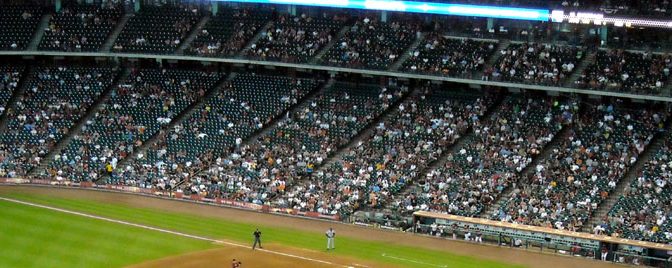
The world of professional baseball has been dark since March. Discussions are underway to return players to the ballparks in a shortened, fan-free season. Photo R. Anderson

Thanks to the arrival of the COVID-19 virus, for many people right now it feels like up is down, and down is up. The virus has also introduced new terms like, social distancing and contact tracing into our vocabularies. As part of its destructive path into everyday life COVID-19 has caused the world of sports to grind to a halt as player and fan safety was given the proper level of respect.

The COVID-19 outbreak tested leagues in a way that many sports had never experienced. Social distancing requirements, as well as limits on crowd size, led to the cancellations of the XFL, NBA, NHL and almost all other sports leagues. On April 10, 2020 the XFL announced it had suspended operations indefinitely and laid off all league employees due in part to financial losses as a result of COVID-19.

The Olympic Summer Games in Tokyo were delayed by at least a year. All NCAA spring sports tournaments, including the Men’s and Women’s Basketball Tournaments were cancelled. Major League Baseball ended Spring Training early, and delayed the start of the season. The leagues that continued to hold competitions did so without fans in attendance as they tried to balance social responsibility with the public’s appetite for live sports.

With most major sports leagues shutdown due to COVID-19, sports fans looked for any port in the storm to quench their thirst for live competition. The American Cornhole League provided many fans with just such an outlet.
Photo R. Anderson

Before going any further, it is important to note that shutting down mass gatherings, like sporting events, was the right call.

One need only look at the amount of cases that spread out from a convention in Boston to know how quickly the virus can spread to know that mass gatherings are simply not prudent at this juncture. Even with social distancing, the number of cases, and the number of fatalities continue to rise. Were sports allowed to continue in full stadiums and arenas, there is little doubt that the case and death count would be much higher.

It should also be said that the inconvenience of not having live sports to watch is trivial compared to the real effects of COVID-19 that many people are facing across the world through losses of jobs and in extreme cases losses of loved ones.

Although the major sporting leagues have been shutdown for nearly two months, there are rumblings building to resume sports, albeit in empty stadiums without fans. NASCAR, which kept fans entertained through simulated races, is set to resume racing in empty tracks on May 17, 2020. Five years after the first game in Major League Baseball history was played in Baltimore without fans, MLB is negotiating with the player’s union to try to gain approval to host a truncated 82 game season in empty ballparks starting in July.

NASCAR is set to resume racing without fans in attendance on May 17, 2020. Time will tell whether the fans return for the Daytona 500 in February at Daytona International Speedway.
Photo R. Anderson

All of these efforts to resume sports without fans show a desire for the governing bodies of the respected sports to explore any and all means for the show to go on. This effort to resume is driven in large part so the leagues can recoup some sort of financial payday.

While a return to live sports on television, even sports without fans, would be welcomed by many, one has to ask whether leagues risk diminishing the product by forcing reduced schedules on fans and trying to call it a full season. Should a World Series Champion that only played an 82-game regular season be considered as talented as teams of the past who prevailed over the course of a season that was twice as long?

Additionally, as part of any discussion on the resumption of live sports one must also ask whether players are being put at undue risk by being asked to travel from city to city, and potential virus hot spot to hot spot, just so the show can go on in some form or fashion.

To be clear, like most sports fans, I miss being able to unwind at the end of the day by watching a game on television. However, I am not sure that I miss live sports enough that I am willing to support putting my favorite athletes potentially at risk of catching, or spreading, a virus that currently has no cure just so they can bring me a few hours of entertainment.

As professional sports look at ways to resume during the era of COVID-19 one has to wonder how exactly a football huddle with social distancing would look.
Photo R. Anderson

Aside from needing to address player safety as part of any path to resumed competition, leagues must also consider that airing games without fans leagues may hasten the trend of people choosing to watch games from the comfort of home versus battling thousands of people to get to a seat so far from the field that they are basically watching the game on the big screen anyway. Sure, the made for TV sports are better with screaming fans, but there is something to be said for watching at home where the snacks and the bathrooms are both a lot easier to get to.

With NASCAR and MLB looking to get their seasons going, the eyes of the world of sports turn their focus to football. Even if one accepts the prospect of empty football stadiums, it is hard to fathom how players could be in the trenches on the gridiron and not risk exposure to COVID-19.

Exactly how does one huddle with six-feet of separation? Even a scenario where players are wearing masks does not seem feasible. It is hard to think that a wide receiver can run full speed down the sideline wearing a N-95 mask under his face mask. The only possible solution would be to equip all player helmets with a clear shield that covers their mouth and nose, but even that is a stretch.

College Football is one of the sports on the bubble for a return based on a NCAA position on the need for students to be on campus before sports can resume.
Photo R. Anderson

College sports face their own hurdles for resuming in the fall. The NCAA has said that sports will not resume unless on campus classes have also resumed. The implication being that if the college is not deemed safe enough for students to be on, then the athletes should not be expected to have to play there.

There is too much money involved in college football to think that a work around of some sort will not be found to play games if the COVID-19 virus is still running rampant across the country come August. The topic of College Bowl Games and the College Football Playoffs is another issue that is bound to get a lot of attention in the coming months based on the millions of dollars at stake.

It is entirely possible that the sports landscape will never return to the levels that it was at before the world of sports was shut down by COVID-19. By adopting an attitude that everyone is in this together, those most impacted by the global timeout in sport can better weather the storm. It is crucial to keep in mind that the current situation is also only temporary.

Perhaps James Earl Jones’ character Terence Mann in the movie Field of Dreams said it best when he said “People will come Ray. The one constant through all the years, Ray, has been baseball. America has rolled by like an army of steamrollers. It has been erased like a blackboard, rebuilt and erased again. But baseball has marked the time. This field, this game: it’s a part of our past, Ray. It reminds us of all that once was good and that could be again. Oh…people will come Ray. People will most definitely come.”

Yes, baseball and other sports will resume at some point, and people will indeed come. How many people are allowed to come over the next few years based on social distancing remains to be seen.

Now if you’ll excuse me, I have some masked competitive cornhole to watch on the Ocho followed by some lawnmower racing.

Copyright 2020 R. Anderson

Superstitious Day for Some, Just Another Day for Others

Editor’s Note: We are taking a break from our regularly scheduled Friday feature on the history of Spring Training over the past 40 years to focus on a superstitious day. We will resume our historic series next Friday with a doubleheader that covers Spring Training in 1985 and 1995. And now without further adieu, we bring you, Friday the 13th.

Today is Friday, February 13, 2015.

For some people this means nothing more than the fact that yesterday was the 12th and tomorrow is the 14th.

For the superstitious among us today means all of the things above in addition to it being an unlucky day all the way around.

While many may think that the Friday the 13th craze started with a certain movie character named Freddy, the roots of Friday the 13th actually run much deeper than late 20th Century cinema.

For many people a black cat crossing their paths is a sign of bad luck. Were that cat to cross their path on Friday the 13th they might think that it was even worse luck.
Photo R. Anderson

Since the 19th Century Friday the 13th has been considered an unlucky day in Western and Eastern superstition.

Friday and the number 13 were considered unlucky by some on their own so it was only logical that both occurring at the same time would be even unluckier.

In fact fear of Friday the 13th even has a name; friggatriskaidekaphobia (Frigga being the name of the Norse goddess for whom Friday is named in English and triskaidekaphobia meaning fear of the number thirteen).

Personally I have never feared Friday the 13th and am among the people who consider it just another day.

But the arrival of Friday the 13th on the same day that many teams started sending their equipment down to their Spring Training facilities made me think about sports and the superstitious rituals that many players seem to follow.

The movie Bull Durham did a very good job showing the superstitious side of baseball through chants over bats, breathing through one’s eyelids, chicken, and of course a garter belt where the rose goes in the front. Photo R. Anderson

There are players who will eat the same pregame meal because they feel that to eat anything else would risk certain disaster on the field.

Hitters on a hot streak in baseball are notorious for continuing whatever “routine” it is that they feel is behind their streak since they feel any deviation will likely mean the end to the streak.

The movie Bull Durham did a very good job showing the superstitious side of baseball through chants over bats, breathing through one’s eyelids, chicken, and of course a garter belt where the rose goes in the front.

Baseball is not the only sport with superstitions. Across all level of sports there are athletes who have a lucky shirt, or other article of clothing that they can’t go onto the field of battle without.

The link between superstitions and sports can start at a very early age.

Back in high school I did a feature article on the goalie of my school’s woman’s soccer team, who attributed her on-field success to a lucky argyle sock that she wore during every game.

Although he could be moody and liked to bite my nose to wake me up each morning, my dearly departed black cat, Lucky, was mostly a sweetheart and was certainly nothing to be superstitious of on Friday the 13th or any other day for that matter.
Photo R. Anderson

Granted it was not a pair of socks but one single sock that took over when her “magic shoes” fell ill.

Throughout my career I have been around many other superstitious athletes, and I am sure I will meet many more. To date though a single “lucky” Argyle sock has been the most memorable superstition I have encountered.

So on this Friday the 13th beware of those around you who are extra cautious of their surroundings.

Now if you’ll excuse me, I am going to see if I can find a black cat while walking under a ladder and holding a broken mirror while stepping on all of the sidewalk cracks I can find.

Copyright 2015 R. Anderson

Today is Set Aside to Honor Those Who Have Served, Sacrificed

Today, the eleventh day of the eleventh month, also known as November 11th, is set aside as Veteran’s Day in America.

The holiday got its start on the 11th hour of the 11th day of the 11th month of 1918, when an armistice, or temporary cessation of hostilities, was declared between the Allied nations and Germany in the First World War.

Commemorated as Armistice Day beginning in 1919, November 11th became a legal federal holiday in the United States in 1938.

In the aftermath of World War II and the Korean War, Armistice Day was renamed Veterans Day, and became a holiday dedicated to American veterans of all wars.

So while this has long been a day set aside to honor the service and sacrifice of the men and women who have served in the armed forces to protect the freedoms that we all enjoy, the way to honor those troops has changed in many ways through the years.

Americans still put out their flags on this holiday. Some towns still hold parades and the banks and post office are still closed.

The honoring of veterans has moved into the nation’s sporting events as well allowing thousands of people to celebrate and remember in mass.

Large American Flags have long beena tradition at sporting events. This past weekend stadiums across the country honored Veterans and America with flags and tributes. One tribute let a sour taste however. Photo R. Anderson
Large American Flags have long been a tradition at sporting events. This past weekend stadiums across the country honored Veterans and America with flags and tributes. One tribute left a sour taste however.
Photo R. Anderson

Watch almost any sporting event over the past weekend and there were displays of patriotism and honoring of the troops as far as the eye could see.

As troops have not always received warm welcomes on the home front it was especially nice to see how the men and women of the armed services are respected and appreciated for their sacrifice.

Had the honoring of the troops stopped at the pregame ceremonies it would have been the perfect way to say thanks. Unfortunately many teams and in some cases leagues took things a tad too far for my taste.

Many teams added camouflage flourishes to their uniforms as an homage to the troops. These flourishes in many cases included camouflage wristbands and towels as well as camo windbreakers and caps for the coaches.

The camouflagication of the sidelines even went so far as putting a camo pattern on the headphones the coaches used to communicate.

While I agree that honoring the troops on Veteran’s Day is a good thing I often cringe when I see people wearing camouflage without “earning it.”

Now, I know this is hunting season in most of the country, or at least down in Texas. So to be clear I am not trying to take away anyone’s right to wear camouflage and a bright orange vest while channeling their inner Elmer Fudd by going hunting for wabbits, deer, or ducks for that matter.

What I am saying is that over the past few years I have become more and more sensitive to people wearing the current style of military camouflage when they are out and about in their daily lives.

Flyovers such as this one by the United States Navy's Blue Angels are perfectly good at sporting events. Players wearing camouflage, not so much. Photo R. Anderson
Flyovers such as this one by the United States Navy’s Blue Angels are perfectly good at sporting events. Players wearing camouflage, not so much.
Photo R. Anderson

I have no issues with people wearing old school green camo since that can usually be determined not to be current issue and looks nothing like what the troops are currently wearing.

I even have a pair of camouflage cargo pants that are extremely comfortable but I made sure that I did not buy the “official” pattern when I got them.

So this weekend when I saw the various players with camouflage towels, and coaches with camouflage hats and headphones, I questioned once again if that was really the best way to honor the veterans.

By comparison when sports teams honor police and fire fighters they do not don S.W.A.T. patterns or simulate a firefighter’s bunker gear proving that one can honor our vets and first responders without dressing like them.

For years baseball players have worn camouflage uniforms a couple times a year to honor the troops so the trend is certainly not limited to football.

I certainly can be in the minority opinion here but to me the camouflage the troops wear is earned through the sacrifice of making it through basic training and then further tested through battle.

Using a camouflage towel to wipe up sweat between plays on the field just seems wrong to me.

In one of the games I was watching one of the camouflage towels fell to the turf and was stomped on as the players moved to that area of the field.

I know that the towel was not dropped intentionally, but seeing the image of that fallen towel had the same reaction for me as if I was seeing an American flag on the ground.

I guess I look at the camouflage that the troops wear as an extension of the flag that they are sworn to protect.

It would be deemed highly inappropriate for a football player to have a sweat towel that looked like the American flag on the field so in the same way the camouflage towels just seem equally inappropriate to the point of being offensive.

Again, I know that the intent of the teams and league is completely honorable and meant to pay tribute to the troops but the execution just strikes me as wrong.

Honor the troops with the 100-yard flags that are rolled out for the National Anthem and held by real soldiers in uniform.

Honor the troops by having people stand and cheer when a vet is on Jumbotron screen.

Honor the troops by thanking a veteran for their service.

These are perfectly fine ways to honor the troops without trivializing the uniform.

Again, I may be completely out on a limb here and perhaps the masses see no issues with the camouflage being used by athletes and coaches.

But to me it screams out like a cheap gesture and also a way to make money as the camouflage caps are often available for purchase by fans.

I have never served in the military and do not pretend to be able to speak for the troops.

To do that a few years back I asked an Army reservist their thoughts on the uniform pattern being worn by non-soldiers and they said, “Camo is a uniform worn by the military and should be given the proper respect. Too many have died with the uniform on for it to be the latest fashion trend.”

And again before I get angry replies from hunters neither I, nor the soldier quoted above, are referring to the camouflage cap you can get at Walmart with your hunting camouflage pattern and favorite team’s logo on it.

I am talking about the use of the current military camouflage pattern and nothing else.

So, on this Veteran’s Day if you see a soldier, make sure you thank them for their service which makes your freedom possible. For that matter thank a veteran any time you happen to cross paths with them since thanks should not be limited to a single day of the year.

And if you see an athlete wearing camouflage know that their heart is likely in the right place. But try not to go out and buy the same camouflage cap they are wearing since there was a price paid and a sacrifice made every day by thousands of Americans in that pattern and wearing that comes with a willingness to make the ultimate sacrifice for your country.

Now if you’ll excuse me, I have a flag to place on the patio

Copyright 2015 R. Anderson

Passing of Yogi Berra Leads to Deja Vu at Triple B

Editor’s Note: In honor of Yogi Berra, who passed away at the age of 90, it is deja vu all other again as we take a look back at a column from June 14, 2014 pertaining to the D Day invasion that Yogi Berra and so many other members of the Greatest Generation took part in. Despite long odds and adversity Yogi Berra, and the other men who stormed those beaches, proved that it is not over, until it is over. Thanks for all of the quotable memories Yogi and for your great service to America through both the Military and as an ambassador for generations of baseball fans. You truly were one of a kind.

Today marks the 70th Anniversary of D-Day, which is the name given to the World War II battle involving over 156,000 American, British and Canadian forces landing on five beaches along a 50-mile stretch of the heavily fortified coast of France’s Normandy region in one of the largest amphibious military assaults in history.

Led by Supreme Allied Commander General Dwight D. Eisenhower, the Allied forces stormed beaches at Normandy code named Sword, Juno, Gold, Utah and Omaha.

The storming of the beaches was met by German machine gunners and artillery who tried to hold back the invasion force, almost succeeding at Omaha costing the Allies more than two thousand casualties in the opening hours.

For an idea of just how gruesome this type of frontal beach assault is one need only watch the opening of Saving Private Ryan. It is easy to forget in this era of drone attacks and smart bombs that war was once much more hand to hand leading to much higher casualty rates among its participants.

The guns on the USS Texas provided cover for the troops storming the beaches during D-Day. The flag that flew on the ship during the battle will be on public display starting today. Photo R. Anderson
The guns on the USS Texas provided cover for the troops storming the beaches during D-Day. The flag that flew on the ship during the battle will be on public display starting today.
Photo R. Anderson

In total, the Battle of Normandy lasted from June 1944 to August 1944 resulting in the Allied liberation of Western Europe from Nazi Germany’s control and has been called the beginning of the end of war in Europe.

During the D-Day invasion all scheduled baseball games were canceled on June 6, 1944 which marked only the second time in history that games were cancelled league wide.

The first cancellation of baseball games happened on the day U.S. president Warren Harding died in 1923, and the third time was when Commissioner Bud Selig stopped play for six days from Sept. 11-16, 2001, following the terrorist attacks.

While baseball games were cancelled stateside on D-Day, two future Hall of Famers, Yogi Berra and Leon Day, were participating in the battle.

Shortly after being drafted by the New York Yankees Hall of Fame catcher Yogi Berra was drafted by Uncle Sam. Berra witnessed D-Day 70 years ago today as a member of the U.S. Navy. Photo R. Anderson
Shortly after being drafted by the New York Yankees Hall of Fame catcher Yogi Berra was drafted by Uncle Sam. Berra witnessed D-Day 70 years ago today as a member of the U.S. Navy.
Photo R. Anderson

According to the National Baseball Hall of Fame, 35 Hall of Fame members and more than 500 Major League players served in World War II.

Many celebrations are planned today to mark the anniversary. In France various heads of state are visiting Normandy and closer to home the people of Houston, and the surrounding areas, will have their own chance to see a piece of D-Day history starting today.

The Houston Museum of Natural Science will give the public an opportunity to see the 17-by-9 foot battle flag that was waving on the USS Texas during D-Day.

Although the USS Texas itself has been on static display for many years, the exhibit at the Houston Museum of Natural Science marks the first time since World War II that the flag has been on public display.

Whether one travels to see the beaches of Normandy, or the Stars and Stripes, it is important to remember the sacrifice of all of those veterans who stormed those beaches to help ensure the freedom that is enjoyed to this day.

After serving in World War I the USS Texas was called into action on D-Day. Seventy years after that battle the ship remains as a monument to the people who fought and died to help bring the freedoms we know and love. Photo R. Anderson
After serving in World War I the USS Texas was called into action on D-Day. Seventy years after that battle the ship remains as a monument to the people who fought and died to help bring the freedoms we know and love.
Photo R. Anderson

Unfortunately the time to thank a World War II veteran in person is vanishing rapidly.

The United States Veteran’s Administration estimates that a World War II veteran dies around every two minutes. That translates to a rate of approximately 555 veterans dying each day.

By the year 2036, the VA estimates, there will no longer be any living World War II veterans.

For comparison purposes the last World War I veteran, Frank Buckles, died in February 2011.

A reminder of the rapid passing of World War II veterans occurred Wednesday when, Chester Nez, died at age 93.

Nez was the last living member of the original 29 citizens of the Navajo Nation who were recruited by the Marine Corps to develop the legendary “unbreakable” code based on the Navajo language that was used for vital communications during battle.

Just as the sacrifice made on the beaches of Normandy saved countless lives by hastening the end of the war in Europe, the Code Talkers helped end the war on the Pacific front with their sacrifice.

There are countless other stories of bravery and sacrifice from the men and women of the “Greatest Generation” who served during World War II and each story goes towards the patchwork on which the nation is built.

It is likely, and hopeful, that the world will not see another war of the scale of World War II. While there will always be a need for a certain amount of boots on the ground advancements in technology have greatly reduced the number of boots required to conduct modern warfare.

But while the number of soldiers needed to protect freedom will continue to decline in the coming years that does not minimize the level of sacrifice made by each of the soldiers who wear the uniform.

So take some time before the start of the hustle and bustle of the weekend to remember the sacrifice and reflect on the high cost of freedom paid by each generation that has gone before.

And by all means if you happen to see a World War II veteran, or any other veteran for that matter, be sure to thank them for their service and their sacrifice.

Now if you’ll excuse me, I have a flag to visit.

Copyright 2015 R. Anderson


Triple B Flashback: The Beaches of Bond, James Bond

Editor’s Note: For the remainder of June we will be counting down our 10 favorite columns as we celebrate summer vacation. Coming in at number 7 on our countdown is a column from February 11, 2013.

This year marks the 50th anniversary of Ian Fleming’s master spy James Bond’s debut on the silver screen. As part of the celebration there have been countless ceremonies and other specials to commemorate the event.

From Daniel Craig “parachuting” into the London Olympic Games with the Queen, to the planned tribute later this month at the Academy Awards, it is hard to argue that this is the year of Bond, James Bond.  With all of these activities and the DVD release of Skyfall tomorrow it seemed like a perfect time to focus on 007.

Some of the 23 James Bond movies.
Photo by R. Anderson

Now, it would be easy to try and rank the men who have played James Bond on film. From Sean Connery to Daniel Craig, and everyone in between, most people when asked have a favorite.

One common theory of Bond relativity is that a person’s favorite portrayal tends to coincide with whoever was Bond the first time that they watched.  For me, my first exposure to Bond occurred during the Roger Moore era.

Looking back now, the Roger Moore movies were some of the campiest in the franchise. That is in no way speaking ill of them. In fact, Sir Roger Moore himself has stated that he was in on the joke and wanted to play Bond in a campy manner with a wink and a nod to the audience.

In many ways, Sean Connery and Daniel Craig portray a Bond that is truer to the source material than the Roger Moore installment.  Don’t get me wrong, I enjoy the Bond portrayals by Connery and Craig, but for whatever reason  I still tend to picture Bond as Roger Moore.

I do not hold the same affinity for Pierce Brosnan and Timothy Dalton.  I enjoy other films that Brosnan and Dalton are in, but just do not care for them as Bond.

Timothy Dalton seemed to be trying too hard, and Pierce Brosnan seemed like he wasn’t trying hard enough during their stints in the tuxedo.

The final of the six men to play Bond, George Lazenby, gets an incomplete grade.  I thought that his turn as Bond was pleasant enough but it is hard to say with only one movie to go by.

After the list of favorite Bond actor is decided, the next logical step that fans are likely to take is picking their favorite Bond girl.  In the early films one knew that there would be two Bond girls; the one that was the first to fall into the arms of Bond and the second more complex one.

It was a well-known fact that, much like the person wearing the red shirt on the away team for the original Star Trek, the first Bond girl in each film would surely meet her demise in some cruel fashion shortly after exclaiming the phrase, “oh, James.”

The second Bond girl could be a baddy that was turned good by the power of Bond persuasion or someone else that we were led to believe won the heart of James and would be seen in some sort of embrace as the credits rolled.

So, debate amongst yourselves and pick your favorite Bond girl. For me, that title goes to Vesper Lynd, played by Eva Green in 2006′s Casino Royale.

One could also set up a list of best cars, gadgets, or villains.  There really is no end to the amount of debate that one can give to the subject.  This is one of the many reasons for the lasting appeal of James Bond.

But for our purposes, let us focus on the beaches of Bond.  The mood for the appeal of the sea and the role exotic locations would play in the franchise was set early on in 1962′s Dr. No.

Ask anyone who has seen the movie, and odds are they will recall Ursula Andress emerging from the ocean in her white bikini with a dagger strapped to her hip as the waves rushed onto the shore.

So pivotal was that moment in the franchise, years later the producers tried to recreate it with Halle Berry in Die Another Day. And since this is a new era for Bond the fans were given the chance to see Daniel Craig emerge from the surf in much the same way in Casino Royale.

Part of the recurrence of beaches in Bond movies goes back to the source material and Ian Fleming himself.  When Fleming was writing the novels that would inspire the film franchise, he had a vacation home called Goldeneye in Jamaica.  This proximity to the tropical environment came through as three of Fleming’s thirteen James Bond novels, “Live and Let Die”, “Doctor No” and “The Man with the Golden Gun” have Jamaican settings.

Some of Ian Fleming’s books.
Photo R. Anderson

Other beaches would follow in the films after Dr. No‘s Jamaican holiday.  In no particular order are several memorable beaches of bond.  Khao Phing Kan, Thailand in The Man With the Golden Gun, Holywell Bay, Cornwall, England, in Die Another Day, Praia do Guincho, near Cascais, Portugal, from On Her Majesty’s Secret Service, and One and Only Ocean Club, Bahamas from Casino Royale.

While the movies allowed the viewer to see the beaches the books allowed one to picture the beaches in their mind as they read along.  Arguments can be made either way regarding which is better as the debate over books versus films has raged on for decades if not longer.

For me I tend to prefer picturing things in my mind first and seeing them second.  But few can argue that the beaches of the films are truly spectacular and add to the visual story that is trying to be told.

And back to that first beach from Dr. No; you know the one that started it all.  It has of course been renamed James Bond Beach. No word on whether the sand is best shaken or stirred when it gets stuck in one’s swim trunks.

Now if you’ll excuse me, I think it is time to update the passport and fly out to see some of these beaches in person.

Copyright 2013 R. Anderson